



The New Food Pyramid: The End of the Cereal Era and the Return of the Egg
The Collapse of a Myth: January 7th
On January 7th, the nutritional world in the United States shook to its core. The announcement of the new nutritional guidelines (what we popularly call the “New Food Pyramid”) marked a historic paradigm shift. After decades of demonizing natural fats and glorifying grains, science has finally forced a correction. The old 1992 pyramid—the one that suggested eating 6 to 11 servings of bread, pasta, and cereals daily—has been exposed for what it truly was: a metabolic disaster.
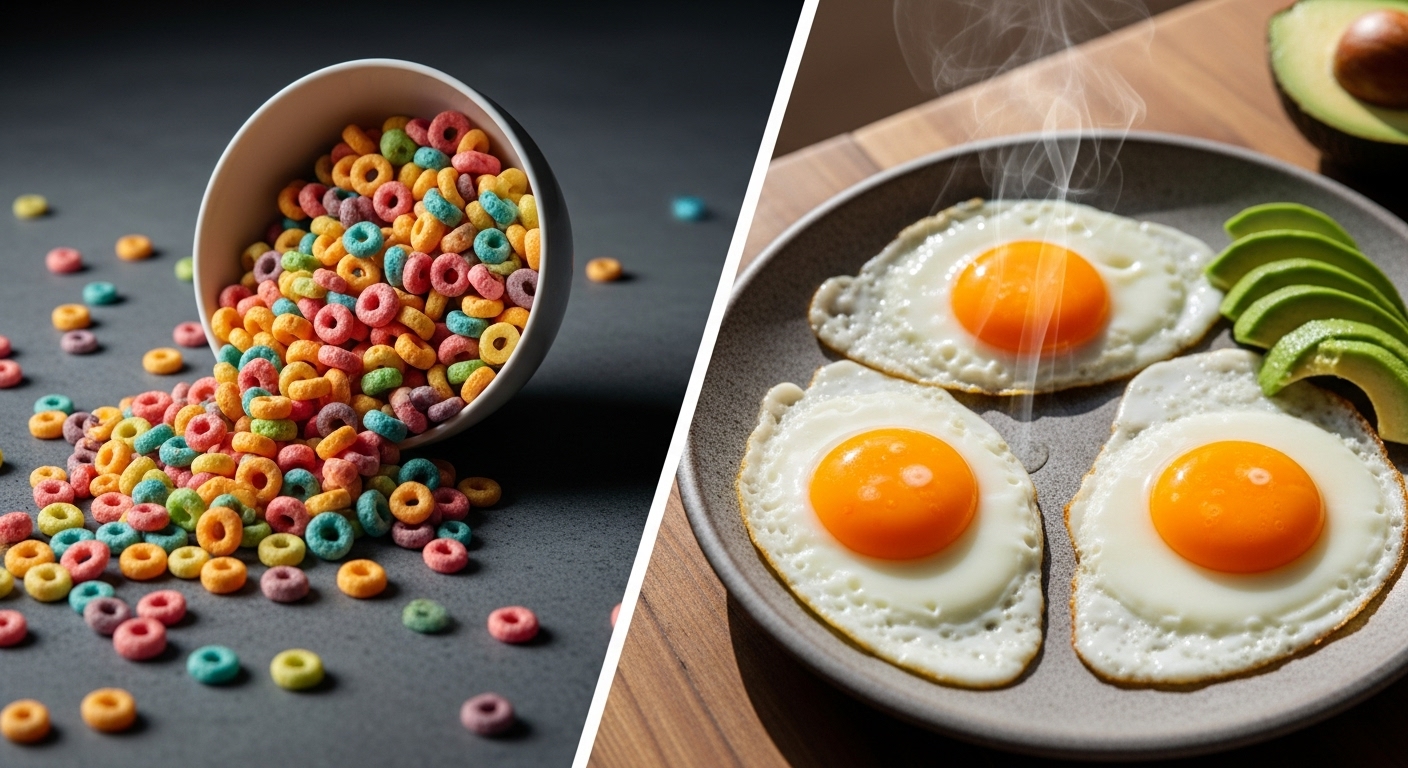
Today, we put two breakfast contenders under the microscope. In one corner, the industry favorite: boxed cereal (Kellogg’s style). In the other, nature’s perfect capsule of life: 3 whole eggs.
The evidence is overwhelming. Brace yourself.
Round 1: The Physiology of Breakfast (Pure Science)
Cereal: The “Fortified” Sugar Bomb
Let’s analyze a typical bowl of processed cereal (corn flakes or colorful loops). The industry tells you it’s “healthy” because it’s low fat and “fortified.”
- The Biochemical Reality: Cereal is a refined grain. The moment it enters your mouth, the amylase enzyme in your saliva is already converting that starch into pure glucose.
- The Impact: Your blood sugar skyrockets (glycemic spike). Your pancreas responds with a torrent of insulin to shuttle that toxic sugar out of the bloodstream and store it as visceral fat.
- Fake Vitamins: The vitamins boasted on the box are synthetic, sprayed onto the final product. Their bioavailability is ridiculous compared to real vitamins found in whole foods.
Eggs: The Perfect Nutritional Matrix
Let’s analyze 3 eggs scrambled with butter.
- Real Protein: They contain every essential amino acid in the exact proportion the human body requires.
- Choline & Fats: The yolk is rich in Choline (vital for the brain) and healthy fats that do not spike insulin.
- Metabolic Stability: Because there are no carbohydrates, there is no glucose spike. Your energy is stable, like a constant flame, not like a firework that explodes and then vanishes.
Round 2: The Satiety Trap vs. The Rollercoaster
This is where the industry keeps you as a captive customer.
The Cereal Cycle (The Rollercoaster):
- You eat cereal at 8:00 AM.
- Massive insulin spike at 8:30 AM.
- The Crash (Reactive Hypoglycemia): By 10:30 AM, your blood sugar drops below normal.
- The Result: Your brain panics, releasing ghrelin (hunger hormone) and cortisol (stress). You feel anxious, irritable, and have an uncontrollable desire to eat more sugar.
- Great Business: They sell you the mid-morning “cereal bar.”
The Power of the Egg (Real Satiety): Eating 3 eggs triggers a potent release of Peptide YY (PYY), a hormone that tells your brain “I am full.” The slow digestion of proteins and fats keeps you satiated for 5 or 6 hours without even thinking about food. No crash. No cravings.
Round 3: The Silent Epidemic (Diabetes and Obesity)
Since the mass introduction of breakfast cereals and the adoption of the low-fat/high-grain pyramid in the late 70s and early 80s, the graphs for obesity and Type 2 diabetes in the West have shot up in an almost vertical line.
- Vegetable Oils vs. Animal Fats: To make cereal taste like something without using animal fat, the industry uses oxidized vegetable/seed oils (soy, canola, corn) and industrial amounts of high-fructose corn syrup. This creates chronic cellular inflammation.
- Insulin Resistance: Bombarding your body with refined grains every morning for years destroys your cells’ sensitivity to insulin. The end result is Type 2 Diabetes.
Demolishing Fact: There is zero biological requirement for “refined grains” in the human body. None. However, there are essential requirements for fatty acids and amino acids (abundant in eggs).
The Business of “Eating 5 Times a Day”
Have you ever wondered why people used to eat 3 times a day and didn’t have weight issues, yet now we are told we must eat 5 or 6 times (snacks)?
It is a need created by the nutritional deficit of cereals. If your breakfast is chemically empty (cereal), you need to eat again in two hours. The recommendation to “eat frequently to boost metabolism” is a myth perpetuated to sell processed products with long shelf lives. Eggs, being nutrient-dense, allow the human body to return to its natural state: eat, be satisfied, and forget about food for hours to be productive.
Conclusion: Destroy the Box
The new food pyramid (and evolutionary common sense) makes it clear: Boxed cereal is dessert disguised as breakfast. It is an engineered product designed to be hyper-palatable, addictive, and unsatiating.
Eggs, on the other hand, are the gold standard of nutrition.
- Want to lose fat? Eat eggs.
- Want mental focus? Eat eggs.
- Want to stop being hungry every 2 hours? Throw away the cereal.
Science has spoken. The refined grain experiment has failed. It is time to return to the origin.
References & Scientific Evidence
Below is the evidence supporting the collapse of cereal in the face of the egg.
1. Satiety and Weight Loss Study: Egg vs. Bagel/Cereal
- Title: Egg breakfast enhances satiety and reduces energy intake compared to a bagel breakfast in overweight subjects.
- Description: A classic study (Ratliff et al.) demonstrating that, with equal calories, people who ate eggs for breakfast felt less hunger and ate fewer calories over the next 24 hours compared to those who ate refined carbohydrates (bagels/cereal).
- Evidence: National Library of Medicine – PMC3059529
2. Glycemic Index and Insulin Response
- Title: Glycemic Index of Breakfast Cereals vs. Eggs.
- Description: Data from the University of Sydney and Harvard Health. Shows that “Corn Flakes” have a Glycemic Index of ~81 (very high), while eggs have an index of 0. Cereal causes insulin spikes that promote fat storage.
- Evidence: Harvard Health – Glycemic Index
3. The Breakfast Myth and Marketing
- Title: History of Breakfast Cereal and the “Most Important Meal” Campaign.
- Description: Historical analysis of how Kellogg and General Foods (1944 campaign) invented the idea that “breakfast is the most important meal of the day” and promoted processed carbohydrates over traditional fats to increase profit margins.
- Evidence: The Guardian – How lobbyists made breakfast the most important meal
4. Protein and Thermogenesis
- Title: Dietary protein – its role in satiety, energetics, weight loss and health.
- Description: Scientific review detailing how high-quality protein (like that in eggs) increases thermogenesis (calorie burning) and satiety far more effectively than refined carbohydrates.
- Evidence: British Journal of Nutrition
Medical Disclaimer: The information contained in this article by Caloritrack (a product of KAI STUDIOS, S.A.S.) is strictly educational and informational. While we encourage empowerment through knowledge, neither Caloritrack nor KAI STUDIOS, S.A.S. acts as a medical entity. This content does not substitute in any way the advice, diagnosis, or treatment of a qualified medical professional. Every body is unique; always consult your primary care doctor or specialist before making significant changes to your diet, routines, or lifestyle.