


Does fiber really “clean” your gut? The missing piece in your digestion puzzle
If you’ve ever tried to be healthier, forced yourself to eat giant bowls of salad, whole grains, or oatmeal smoothies, and ended up feeling super bloated, heavy, or full of gas… you are not crazy, and it’s not your fault. Your body was giving you a signal.
For years, we’ve been told the same formula for any digestive discomfort, almost like well-intentioned but incomplete advice: “Eat more fiber”.
The popular idea is that it acts like a magic brush that “sweeps and detoxifies” everything in its path. But if we set aside the commercials and look at how your body’s machinery actually works, the story is much more fascinating: pooping more doesn’t always mean being better nourished or having better digestive health.
Let’s separate the myths from real science, using common sense.
1. What is fiber and does the body absorb it?
Fiber is, biochemically speaking, a type of structural carbohydrate of plant origin (it’s what gives structure to leaves, stems, and peels of plants).
Unlike the proteins, fats, or available sugars you eat, the human body completely lacks the tools (enzymes) needed to break down and digest fiber.
This means something key: fiber does not nourish your cells directly. It doesn’t enter your bloodstream. It passes through your stomach and small intestine practically intact, acting merely as a passenger in your digestive tract.
2. If we don’t assimilate it, why does it help move digestion?
Since we can’t absorb it, fiber serves a purely mechanical function in your body’s plumbing, and it does so in two different ways:
- Insoluble Fiber (The bulk): It doesn’t dissolve in water. It maintains its physical shape and adds weight to waste. By lightly rubbing against your intestinal walls, it wakes up local nerves, triggering the movement that pushes things toward the exit.
- Soluble Fiber (The gel): It mixes with the water in your body to form a viscous gel. This lubricates the tract, softens the passage of stool, and, as a very useful side effect, slows down the absorption of sugars and fats, helping prevent aggressive glucose spikes in your blood.
The forgotten golden rule: The “cement” effect All this movement depends on something almost no one tells you: water. If you decide to suddenly start eating a lot of fiber (because you want to eat healthier), but you don’t drink enough water, that “bulk” has no way to slide. It dries up and literally becomes a cement plug in your intestines. This explains why so many people end up with much worse constipation when they start a “healthy” diet.
3. The great trap: “Filling” the toilet is not the same as “Nourishing” the body
This is where the biggest confusion arises and where TV told us the story backward. When you eat a lot of fiber, you go to the bathroom more often and produce more volume. Many people mistakenly associate this with “cleansing themselves inside.”
But think about it logically: excreting a large amount of something means your body couldn’t use that matter. Going to the bathroom isn’t “cleansing,” it’s discarding what is useless or what you couldn’t assimilate.
Think of your body as if it were assembling furniture. If you use the highest quality wood (high absorption), there are almost no leftovers, and you don’t take any trash out to the street. If you buy things that come in huge cardboard boxes that serve no purpose (fiber), you’ll fill your trash can every day.
To understand this, we need to see the difference between what the label says and what your body actually uses:
- Nutrient Density: It’s what the paper says (example: “this spinach has a lot of iron”).
- Bioavailability: It’s what your body actually manages to extract, absorb, and use from that spinach.
Let’s look at a fascinating example of this: If you base your meals on pure animal protein and natural fats (like eggs and meat), your body breaks that down and absorbs it with almost 100% efficiency in the small intestine. Your body uses almost all the “wood” and there are no boxes to throw away. As a result, you go to the bathroom much less, and your stools are small. You don’t go infrequently because you’re constipated; you go infrequently because you absorbed most of what you ate, and there is simply no trash to take out.
Conversely, if you eat a giant bowl of bran, you produce huge stools simply because your body was incapable of using most of that plant matter. Volume does not equal nutrition; often, making a lot of bulk is just a sign that you aren’t absorbing much.
4. The other side: Why does “healthy” sometimes make you feel so bad?
All that fiber you didn’t digest reaches your large intestine (the colon) almost fully intact, where trillions of your bacteria live. Since you can’t digest fiber, they eat it and ferment it.
- In a perfectly healthy gut: This fermentation is silent and produces very useful compounds that provide energy to your colon walls.
- In a sensitive or inflamed gut: If you suffer from heavy digestion, throwing fiber into this environment is like pouring gasoline on a fire. The fermentation spirals out of control and produces a massive amount of gas. The result is chronic pain, that bloating where you look 6 months pregnant by the afternoon, and stagnant digestion. For you, the classic advice to “eat more fiber” is the worst possible mistake.
The modern trap: “Fake fiber” Beware of supermarket products. Today, many “Keto” bars, “zero-carb” breads, or “fitness” cereals are injected with synthetic fibers or isolated extracts (like inulin or chicory root). For most people, these artificial fibers are the real culprits behind lethal gas and extreme inflammation, causing much more damage than eating a simple apple.
The ancestral alternative: Ferments If raw vegetables or grains inflame you, there’s a trick our grandparents used: fermented foods (like kefir, sauerkraut, or plain unsweetened yogurt). In these foods, good bacteria have already done the heavy lifting and pre-digested the tough part before you even eat it. They nourish your body without causing the gas explosion of raw fiber.
5. And what about people who don’t eat fiber (Carnivore or Keto diets)?
You’re probably wondering: if fiber is the broom, why don’t people who eat pure meat, eggs, and fat (zero fiber) suffer from paralyzing constipation, and why doesn’t the food “rot” inside them? Your biology’s answer will surprise you:
- The secret power of your bile: The trick to these diets isn’t the lack of fiber, but the presence of healthy fats. When you eat fat, your gallbladder releases bile. Bile is an extremely powerful natural lubricant and laxative in your body. It keeps everything soft and gliding, making fiber completely unnecessary for going to the bathroom.
- Zero fermentation = Zero inflammation: By not eating fiber, there is nothing for the bacteria to ferment. Without fermentation, there is no gas. This is why they experience completely flat stomachs; there is simply nothing generating air in their intestines.
- Fast and clean digestion: Meats and fats are digested and absorbed long before reaching the colon, thanks to your stomach acids. There is absolutely nothing “rotting” inside you; the human body is a perfect machine designed to break down meat quickly.
- The gut moves on its own: Your intestines have their own muscles and nerves. They keep pushing the few waste products naturally, stimulated by water and your bile, without needing any fiber to come and “scrape” to force the movement.
(Note on the adaptation period): If you ever decide to ditch carbohydrates, your body will go through a transition. While your gallbladder learns to send the exact amount of bile, it’s normal to have sudden bathroom changes in the first few weeks. It’s not that it doesn’t suit you; it’s your body adjusting its gears to its new fuel.
6. Busting the myth: How many times is it “normal” to go to the bathroom?
For years we’ve been led to believe that if you don’t go to the bathroom every day, or even twice a day, you are “intoxicated.”
Real science tells us something much more comforting: the important thing is not how often you go, but how you go.
Perfect digestion means that when you go, it’s effortless, painless, without inflammation, and with a soft consistency. On diets where your body absorbs almost all the food, going to the bathroom every two or three days is perfectly natural and physiologically healthy, as long as there’s no discomfort. If you used all the wood, there is no rush to take out the trash.
7. The practical guide: Who SHOULD eat fiber and who SHOULD NOT?
Nutrition isn’t about stuffing things in just because they are said to be “healthy,” but about giving your body what it absorbs best with the least effort.
Sometimes, fiber acts as an “antinutrient.” Many plants have defense compounds (so they don’t get eaten in the wild) that bind to vital minerals in your gut (like zinc, iron, and calcium) and drag them down the toilet along with the fiber. In other words, sometimes excess fiber steals your nutrients.
So, how do we apply all this to your life?
You should minimize (or avoid) fiber if:
- You seek to maximize your absorption: If you follow a diet based on animal proteins and fats (clean Keto or Carnivore), you are already eating the purest and most absorbable food in existence. Adding fiber to that is like putting speed bumps on a race track; it only hinders your digestion.
- Your gut is damaged or highly sensitive: If you suffer from irritable bowel syndrome, constant gas, chronic pain, or the famous SIBO, your gut needs a vacation, not more work. You need dense foods that are absorbed quickly high up in the digestive tract (bone broth, eggs, meat) to stop feeding the chaos and fermentation in your colon.
You should consume fiber if:
- You eat carbohydrates (fruits, rice, grains, sweets): You absolutely need it. Soluble fiber acts as a “handbrake” that prevents the sugar in those foods from spiking suddenly in your blood.
- You have an ironclad digestion: If you can eat a plate of broccoli or beans and your stomach remains flat and calm, great! Your system tolerates it perfectly.
- You are quitting junk food: If you are coming from years of eating ultra-processed foods, vegetables serve as “training wheels” to re-educate your gut.
The “Safe List”: Smart choices without inflammation
If you discovered that you are in the group that DOES need or want to consume fiber, you don’t have to resign yourself to living with a bloated stomach or losing minerals. The secret to smart nutrition lies in choosing low-fermentation and low-antinutrient foods. Here are your safest options:
- “Gentle” fruits: Kiwi and papaya are digestive superstars; they have natural enzymes (actinidin and papain) that help you digest your food, and their fiber produces almost no gas. Blueberries and raspberries are also excellent, unlike apples or pears (which act as fermentation bombs in your colon).
- “Safe” vegetables: Cooked carrots (the heat softens their fiber, making it super soothing for the gut) and zucchini (pure water and harmless soluble fiber).
- “Deactivated” seeds (The soaking trick): Chia and flaxseed are great for going to the bathroom, but raw, they contain phytic acid (the antinutrient that steals your minerals). The trick? Leave them soaking in water overnight. The water “deactivates” the toxin and leaves you only with the gel (mucilage). This gel acts as a perfect lubricant without stealing your nutrients.
- The Golden Rule to “disarm” vegetables: Plants hide their defenses (toxins) in their armor and in their babies. If you want to eat a vegetable without suffering, apply this evolutionary rule: peel it, remove the seeds, and cook it. (This is why raw tomatoes with skin inflame so many people, but peeled, seedless, well-cooked tomato sauce digests perfectly).
The counterpart: The “High-Performance Arsenal” for perfect digestion without fiber
If you are in the group that chooses to minimize or eliminate fiber (clean Keto or Carnivore), traditional medical science usually scares you by saying: “If you don’t eat fiber, your gut will get sick because the bacteria will stop producing butyric acid”. Don’t be fooled. Eliminating fiber and prioritizing animal protein is not “surviving,” it is thriving biologically. Those who are truly surviving inflammation are the ones basing their diet on cellulose and plant packaging.
Here is the exact arsenal to keep your gut bulletproof and operating at the highest level without touching a single leaf:
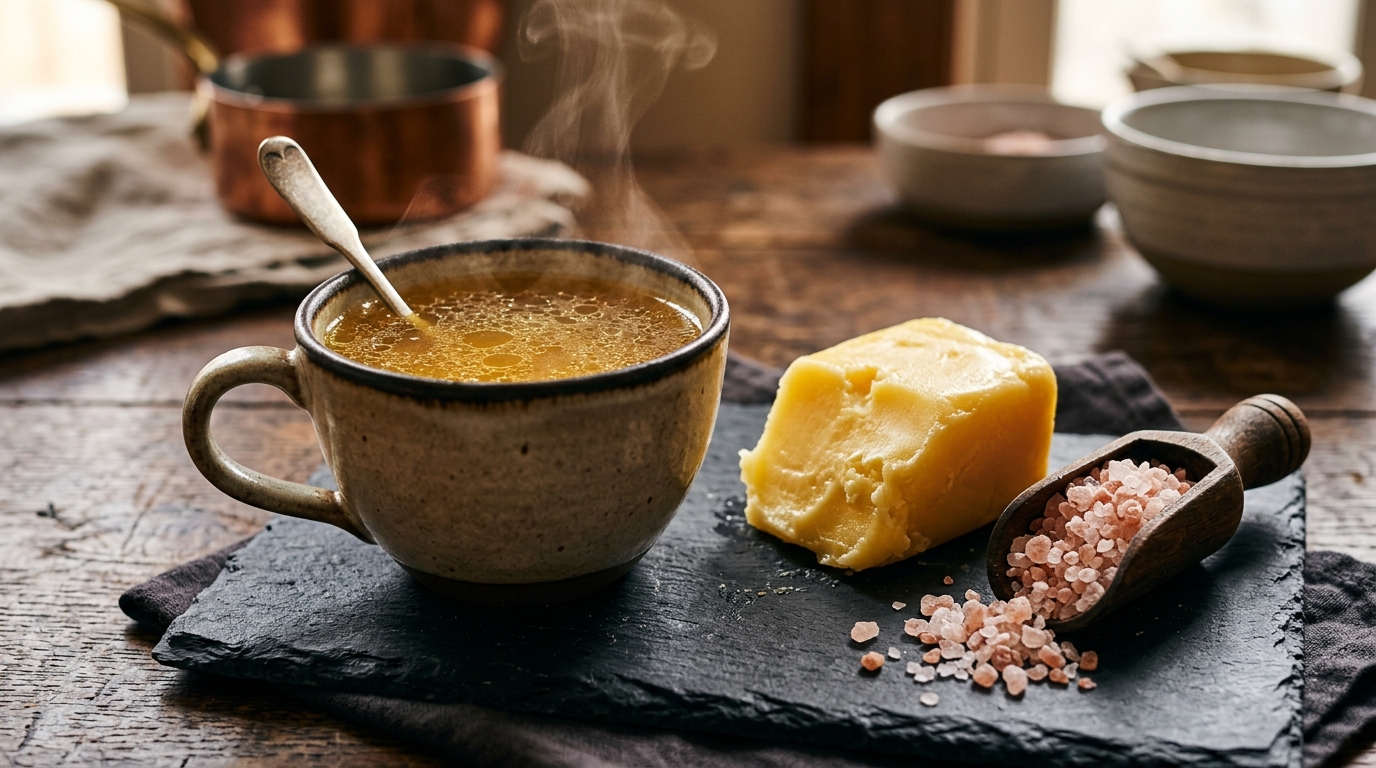
- The master shortcut: Butter and Ghee (Direct Butyric Acid): The main reason they recommend eating fiber is that, when fermented, it produces “butyric acid,” which is pure energy for your colon cells. But you don’t need to ferment anything to get it! Nature already put this acid ready to be absorbed in dairy fat (the word butyric actually comes from butter). Consuming butter or Ghee gives your gut the exact nutrient it needs to heal, skipping the fermentation phase and the gas.
- The ultimate lubricant: Fat + Good Salt: Without fiber adding bulk, your gut relies 100% on bile to keep stools soft. To produce that bile, you need to eat healthy fats. But there is a trick almost everyone forgets: salt. Without enough sodium, your body doesn’t retain water and your stool dries out. The winning combo for perfect bathroom visits without fiber is losing the fear of animal fat and using good salt (sea salt or Himalayan) to keep everything hydrated.
- The sealant for your new flora: Bone Broth: “If you don’t eat plants, your bacteria die.” False; your bacteria simply change. The ones that survive on a high-absorption diet feed on protein residues and cartilage. Consuming real bone broth (rich in collagen, glycine, and glutamine) acts as the perfect supplement. Not only does it feed this new bacterial profile, but it also repairs and seals your intestinal walls, curing deep inflammation.
In summary:
- Fiber is not magic, nor is it poison: It’s a tool of nature that slows down sugar and moves waste. For some, it’s an ally; for others, the cause of their pain.
- Your gut is not a trash can, it’s an extractor: Its job is not to produce mass waste to “cleanse” you; it is to extract nutrients to give you life.
- Listen to your body, not general rules: True digestive health is not a trophy for going to the bathroom every day. It’s your ability to absorb your food, have stable energy, and live your day-to-day life without a bloated stomach.
📚 Scientific References
1. The Fiber Myth and Constipation (The “Cement” Effect)
- Study Title: Stopping or reducing dietary fiber intake reduces constipation and its associated symptoms.
- Description: A definitive clinical study where patients with severe chronic constipation were told to stop eating fiber altogether rather than increase it. The result: 100% of the patients on a zero-fiber diet saw complete resolution of their constipation, bloating, and pelvic pain, proving that excess fiber acts more like a plug than a broom.
- PubMed Link: https://pubmed.ncbi.nlm.nih.gov/22969927/
2. Microbiome Adaptation to Carnivore/Keto Diets (Bacteria and Bile)
- Study Title: Diet rapidly and reproducibly alters the human gut microbiome.
- Description: Published in Nature, this study demonstrates what happens when humans switch to an exclusively animal-based diet (meat, eggs, cheese) with zero plant fiber. It shows that the microbiome adapts in less than 24 hours, thriving with bile-tolerant microorganisms and protein-fermenting bacteria, while stopping the gas production associated with carbohydrate fermentation.
- PubMed Link: https://pubmed.ncbi.nlm.nih.gov/24336217/
3. Fiber Fermentation as a Cause of Inflammation and Gas (FODMAPs)
- Study Title: Evidence-based dietary management of functional gastrointestinal symptoms: The FODMAP approach.
- Description: This study supports the “safe list” and explains why specific fermentable plant carbohydrates and fibers are the primary triggers for extreme bloating, SIBO, and Irritable Bowel Syndrome (IBS). It validates that removing these fibers is the most effective tool for reducing gut inflammation.
- PubMed Link: https://pubmed.ncbi.nlm.nih.gov/20136989/
4. Fiber as an “Antinutrient” (Phytic Acid and Mineral Loss)
- Study Title: Phytate in foods and significance for humans: food sources, intake, processing, bioavailability, protective role and analysis.
- Description: A comprehensive review of how phytic acid (found in the fiber of seeds, nuts, legumes, and grains) acts as a biological antinutrient. It binds to vital minerals like iron, zinc, and calcium, preventing the intestine from absorbing them. It also supports the logic behind soaking and cooking to deactivate these toxins.
- PubMed Link: https://pubmed.ncbi.nlm.nih.gov/19774556/
5. Butyric Acid without Fiber (The Magic of Ghee and Butter)
- Study Title: Butyrate: A double-edged sword for health?
- Description: This review analyzes the function of butyrate (the short-chain fatty acid vital for colon health). Scientific literature confirms that butyric acid—which the body normally derives from fermenting fiber—is naturally and abundantly present in its direct form in dairy fats (like butter and Ghee). This allows for gut nourishment without the cost of gas and fermentation.
- PubMed Link: https://pubmed.ncbi.nlm.nih.gov/29436595/
6. Bile and Fat as the Ultimate Lubricant
- Study Title: The effects of regional delivery of bile acid to the human colon.
- Description: This explains why people on high-fat, zero-fiber diets (Carnivore/Keto) have perfect bowel movements. The study physiologically demonstrates that bile acids (released to digest fats) stimulate colonic motility and mucosal fluid secretion, acting as a powerful natural laxative and lubricant.
Medical Disclaimer: The information contained in this article by Caloritrack (a product of KAI STUDIOS, S.A.S.) is strictly educational and informational. While we encourage empowerment through knowledge, neither Caloritrack nor KAI STUDIOS, S.A.S. acts as a medical entity. This content does not substitute in any way the advice, diagnosis, or treatment of a qualified medical professional. Every body is unique; always consult your primary care doctor or specialist before making significant changes to your diet, routines, or lifestyle.