




The Egg White Omelet: Why Throwing Away the Yolk is a Nutritional Mistake (and the Great Cholesterol Myth)
If you have ever ordered an “egg white only omelet” thinking you were doing your body and your waistline a favor, it’s time to talk seriously. For decades, we have been sold the idea that the egg yolk is the enemy—a cholesterol and calorie bomb headed straight for our arteries and our waist.
But science advances, and today we know that asking for an omelet without yolks is not only a grave nutritional mistake, but it is also based on obsolete information. Let’s talk about quality versus quantity, how your metabolism truly works, and why throwing the yolk in the trash should be a thing of the past.
The Yolk vs. The White: The Nutritional Combat
We’ve been told that the egg white is “pure protein” and the yolk is “pure fat.” But if we analyze the nutritional density of both parts, the story is entirely different. The white is essentially water and protein, while the yolk is nature’s true multivitamin capsule.
Here is a direct comparison of what you are missing out on when you order your egg white omelet:
| Nutrient | The White (60% of weight) | The Yolk (40% of weight) |
| Protein | ~3.6 grams | ~2.7 grams |
| Healthy Fats | 0 grams | ~4.5 grams (including Omega-3) |
| Cholesterol | 0 mg | ~185 mg |
| Choline (Vital for brain and liver) | Almost non-existent | Highly concentrated (One of the best natural sources) |
| Vitamin A (Vision and immunity) | 0 IU | 245 IU |
| Vitamin D (Bones and hormones) | 0 IU | 18 IU |
| Vitamin E (Antioxidant) | 0 mg | 0.4 mg |
| Vitamin K (Blood clotting) | 0 mcg | 0.119 mcg |
| Vitamin B12 (Cellular energy) | 0.03 mcg | 0.33 mcg |
| Folate (Vitamin B9) | 1 mcg | 24 mcg |
| Iron | 0.03 mg | 0.46 mg |
| Zinc | 0 mg | 0.39 mg |
| Lutein and Zeaxanthin (Eye health) | 0 mcg | Highly concentrated |
| Calcium | 2 mg | 22 mg |
As you can see, almost all the vitamins, minerals, and antioxidants are in the yolk.
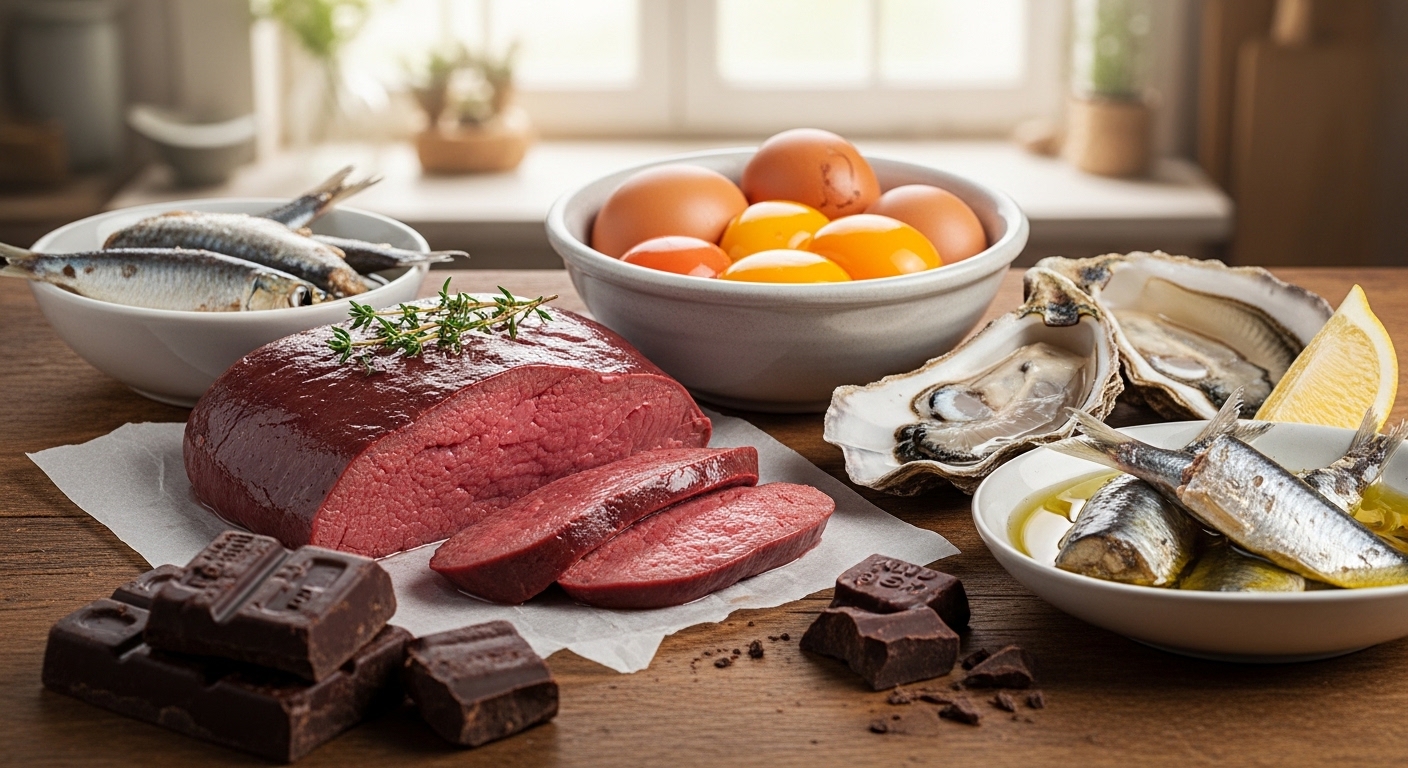
In fact, it is difficult to find another food on the entire planet that is more nutritionally dense than a whole egg (perhaps only surpassed or equaled by organ meats, like beef liver). And here enters a fundamental scientific concept that many ignore: bioavailability. Don’t be fooled by the supplement industry, nor try to compensate for the lack of yolk with pills. You can swallow a handful of those commercial synthetic multivitamins, but your body will barely absorb a tiny fraction of what the label promises. In contrast, the nutrients in an egg come packaged by nature in the perfect matrix—alongside the exact healthy fats needed to dissolve fat-soluble vitamins (A, D, E, K)—so that your body recognizes them, absorbs them, and utilizes them to the fullest. The whole egg is, without a doubt, the best (or one of the best) natural multivitamins that exist.
The Problem with Outdated Nutritionists
Even today, there are nutritionists who tell you to eat the egg without the yolk. If you are seeing one of them, do yourself a favor: run away from there. A nutritionist who prioritizes caloric quantity over nutritional quality is empirically demonstrating that they have no idea about the physiological complexity of the human body. This is a professional who hasn’t taken the time to study the history of nutrition, critically review modern scientific literature, read new clinical trials, or analyze recent meta-analyses. Sadly, they become an academic parrot repeating obsolete dogmas and likely whatever they were taught in school decades ago, without taking the trouble to verify the evidence with a minimum of scientific and intellectual rigor.
Furthermore, it is highly likely that during your consultation, this type of reductionist specialist won’t even look into the comprehensive biological context of your life. They probably don’t talk to you about how much you sleep, the architecture and quality of your sleep (REM phase and deep sleep), your allostatic load, and how you manage your daily stress. It is almost certain they completely omit the critical importance of physical activity focused on strength and muscle mass development, ignoring that muscle isn’t just for moving around, but a vital endocrine organ for metabolism.
Removing a yolk full of essential nutrients and bioactive fats just to save 50 calories is failing to understand how thermodynamics work in a hormonal system. There are variables far more important for weight loss than simply counting empty calories. If you are not managing your stress well (spiking your cortisol) or if you are not sleeping well (altering your insulin sensitivity), your body will not release fat, no matter how many yolks you remove from your plate.
Being overweight or obese is not just an issue of eating “too much”; it is a symptom that something is wrong with your metabolism. Let’s be clear: there are no “healthy fat people.” A constant excess of adipose tissue is an indicator of low-grade systemic inflammation and insulin resistance. The correct order is this: you have to heal your body to be able to lose weight, not lose weight to be healthy. And to heal, you need the quality micronutrients that come from whole foods, like the egg yolk.
As if that weren’t enough, these dogmatic specialists forget a key factor in any process of metabolic improvement and real weight loss: satiety. The healthy fats and nutritional density of the yolk act in synergy to keep you full and satisfied for hours, stabilizing your blood glucose. An egg white-only omelet, lacking these fats, causes hunger spikes, will leave you feeling empty after an hour and a half, and will make you end up with cravings, snacking between meals, or looking for refined carbohydrates mid-morning. Eating the yolk takes away your anxiety and shields you against binge eating.
Additionally, there is an ethical component we cannot ignore. Wasting the yolk and throwing it in the trash out of an irrational fear of calories is an insult to the animals that provide us with food and to life itself. If you crack an egg, eat the whole thing.
The Great Cholesterol Myth and the Ancel Keys Deception
“But, what about my cholesterol?” This is the greatest unfounded fear in the history of nutrition.
It all started in the 1950s with a scientist named Ancel Keys and his famous “Seven Countries Study.” Keys hypothesized that dietary saturated fat and cholesterol caused heart disease. The problem is that his study was highly biased: from the available data of 22 countries, he selected only the data from 7 countries that confirmed his theory and hid the information from the other 15 countries where people ate high-fat diets but had extremely low rates of heart attacks (like France or Switzerland), results that completely contradicted what he wanted to prove.
This study was not a simple accident or an isolated deception that authorities innocently fell for. On the contrary, the United States government and its primary health institutions supported Ancel Keys, endorsed this flawed science, and turned it into public policy. And through a domino effect from that official platform, the whole world was deceived. Healthy fats were demonized, giving way to the era of “low-fat” products loaded with refined sugars and carbohydrates.
Today, science is conclusive: there is no rigorous study proving that the cholesterol you eat in food raises bad blood cholesterol or brings about cardiovascular problems in the general population. Your liver produces most of your body’s cholesterol because you need it to synthesize vitamin D, maintain healthy cell membranes, and critically, because cholesterol is the absolute key and raw material for hormone production. It is the fundamental building block of steroid hormones. Without enough cholesterol, your body cannot produce optimal levels of testosterone, a hormone of vital importance (in both men and women) for building and maintaining muscle mass, having high vital energy levels, regulating metabolism, and managing mood. It is also indispensable for creating estrogen, progesterone, and cortisol. Depriving your body of natural dietary cholesterol is suffocating your endocrine system. If you eat more cholesterol, your liver simply produces less to balance it out.
(A small historical precision note showing that authorities already know this: although the US no longer uses the “food pyramid” model, in the recent updates of their official Dietary Guidelines, the scientific committees quietly removed the strict limit on dietary cholesterol consumption, effectively admitting they were wrong for years).
Conclusion
Stop ordering the egg white omelet. You are not being healthier; you are missing out on one of the most nutritious foods on the planet, you are altering your metabolism by depriving it of good fats and key vitamins for your hormones, and you are perpetuating a myth that science has already buried.
Eat whole eggs, get your 8 hours of quality sleep, manage your stress, strength train, and focus on nourishing your body. Only then will you heal your metabolism and reach your ideal weight.
I sincerely invite you to take control of your own health. Question what you hear, do your own research, and stop blindly believing the typical casual hearsay or “watercooler advice” from friends or acquaintances; it’s highly likely those recommendations are influenced by the same dogmatic nutritionists we just talked about. It is very human to fall into confirmation bias and want to seek only the information that tells us we are right that “eating without the yolk is better” (after all, it was repeated to us for years), but give yourself the opportunity to open your mind. Your body will thank you.
How do you prepare your eggs in the morning? Are you still ordering your egg white omelet, or have you already realized the power of the whole yolk? Leave your experience in the comments below and let’s keep the conversation going!
References & Scientific Evidence
1. The American Journal of Clinical Nutrition (2020)
- Title: Association of egg intake with blood lipids, cardiovascular disease, and mortality in 177,000 people in 50 countries.
- Description: A massive global study assessing thousands of individuals across diverse regions. The research statistically demonstrated that moderate egg consumption (up to one egg per day) is not associated with negative alterations in blood lipids or a higher risk of cardiovascular disease or mortality.
- URL: https://pubmed.ncbi.nlm.nih.gov/31965140/
2. Nutrients (2018)
- Title: Dietary Cholesterol and the Lack of Evidence in Cardiovascular Disease.
- Description: This comprehensive literature review explains in depth the lack of scientific evidence to continue limiting dietary cholesterol. The paper details how the human liver regulates its own cholesterol production based on dietary intake, effectively debunking the myth that eating cholesterol-rich foods like eggs increases cardiovascular risk.
- URL: https://www.ncbi.nlm.nih.gov/pmc/articles/PMC6024687/
3. The BMJ – British Medical Journal (2013)
- Title: Egg consumption and risk of coronary heart disease and stroke: dose-response meta-analysis of prospective cohort studies.
- Description: A dose-response meta-analysis (the highest level of scientific evidence) that analyzed the relationship between egg consumption and heart issues. The conclusion was clear: higher consumption of eggs (up to one per day) is not significantly associated with an increased risk of coronary heart disease or stroke.
- URL: https://www.bmj.com/content/346/bmj.e8539
Medical Disclaimer: The information contained in this article by Caloritrack (a product of KAI STUDIOS, S.A.S.) is strictly educational and informational. While we encourage empowerment through knowledge, neither Caloritrack nor KAI STUDIOS, S.A.S. acts as a medical entity. This content does not substitute in any way the advice, diagnosis, or treatment of a qualified medical professional. Every body is unique; always consult your primary care doctor or specialist before making significant changes to your diet, routines, or lifestyle.