



This is going to hurt: The uncomfortable truth about fats and cholesterol
Everything you were taught about how to take care of your heart, your arteries, and your weight is probably a historical lie that is slowly making you sick. Let’s talk about fats.
For decades, we were sold a horror story where fat was public health enemy number one, the sole culprit for making us gain weight and clogging our arteries. But biology tells a completely different story.
Think about it for a second: your brain is made up of approximately 60% fat and contains 25% of all the cholesterol in your body. Furthermore, every single one of the trillions of cells that make you who you are is wrapped in a cell membrane made of a lipid bilayer (literally built out of fat and cholesterol). Without fat, there is simply no cellular integrity and no life. Fats are the raw material of our bodies, the main fuel for our brains, and the building blocks of our endocrine system.
However, to understand why fat has such a bad reputation, we need to break this story down and meet the real villains first.
The Villains of the Story: Vegetable oils and the Trans Fat trap
Our health problems didn’t start with natural fat; they started when we brought factory technology into our kitchens. We are talking about industrial vegetable oils (canola, soy, corn, safflower, cottonseed oil) and margarine, which is nothing more than highly processed vegetable oil.
They were sold to us as the “light” and heart-healthy heroes, but their physiological reality is destructive:
- An unnatural origin: Unlike squeezing an olive or an avocado, extracting oil from a corn, soy, or cottonseed is a violent process. It requires subjecting the seed to extremely high temperatures, using petroleum-derived chemical solvents (like hexane), and applying deodorizing and bleaching processes to hide their foul smell and color.
- Oxidation and Rancidity: Due to their highly unstable chemical structure, these oils oxidize rapidly with simple exposure to light and oxygen. By the time they finally reach your mouth, many of them are already rancid and broken down.
- The biochemical bridge of inflammation (The Omega-6 Ratio): Your body needs a perfect balance between Omega-3 fats (which reduce inflammation) and Omega-6 fats (which trigger inflammation to heal wounds). Historically, humans consumed a 1:1 ratio. But seed oils are massive, pure bombs of Omega-6. Today, the modern diet has us at a monstrous 20:1 ratio. This brutal excess of Omega-6 is the spark that ignites an inflammatory fire throughout your entire body.
- Cellular destruction from the inside out: Because fats make up the walls of all your cells, your body, having no other choice, uses these Omega-6 packed vegetable oils to build them. By using such an unstable and rancid material, your cell walls become fragile and defective. This generates massive oxidative stress inside you: it’s as if your cells are “rusting” or “drying out” from the inside, directly damaging your mitochondria (your energy engine) and triggering your immune system’s alarms. The result is chronic, silent, and destructive inflammation.
- Hydrogenation and Artificial Trans Fats: To make margarine and prevent liquid oils from spoiling, the industry invented a process called hydrogenation. They inject hydrogen into the vegetable oil to make it solid, creating what we know today as artificial Trans Fats or partially hydrogenated oils. Their molecular structure is twisted in a lab. The human body simply lacks the enzymes to process this “liquid plastic,” causing direct damage to your arteries.
⚠️ ALERT: The difference between Artificial and Natural Trans Fats There is a massive trap with modern supermarket labels here. There are artificial trans fats and natural trans fats, and they act in completely opposite ways in your body. Sometimes you will see a huge black “Warning: Excess Trans Fats” label stamped on a package of authentic Blue Cheese, on real butter, or on a good cut of meat. Those are natural trans fats (like conjugated linoleic acid or CLA), created by bacterial fermentation in the stomachs of ruminant animals. Your biology recognizes them perfectly, metabolizes them without issue, and they even have proven properties to protect against cancer and help burn fat. Governments and labeling laws don’t distinguish the molecular structure and put the exact same warning label on real cheese as they do on factory-made cookies, but your body does know the difference. Natural trans fats nourish you; artificial ones (margarine and hydrogenated oils) make you sick.
The silent invasion in the supermarket: The food industry hides these oils and artificial trans fats in thousands of ultra-processed products (cookies, packaged bread, dressings, mayonnaise, plant-based milks, sauces, desserts, cereals). They add them to absolutely everything for three reasons: they are extremely cheap, they act as artificial preservatives extending shelf life for months or years, and they alter the texture to make food deceptively attractive.
This is where the “fat makes me feel heavy” myth comes from: What really happened is that you didn’t eat natural fat; you consumed food fried in industrial vegetable oil that was burnt and reheated multiple times, as happens with restaurant french fries or typical street food. Those reheated oils are bombs of gastric inflammation.
The Challenge: One day, on an empty stomach, eat a good piece of real pork rinds (chicharrón), fried in its own natural lard. You will realize that there is zero inflammation, zero heaviness, your digestion will be perfect, and you will feel a deep sense of satiety.
The Scapegoat: Your arteries and the cholesterol myth
As they circulate through your blood, oxidized fats injure the endothelium (the delicate inner lining) of your arteries. Your body detects this “wound” and sends cholesterol to try to “patch” the damage. Over time, the accumulation of these scabs of oxidized fats and scar tissue forms arterial plaque.
Blaming cholesterol for clogging your arteries is like seeing a fire, watching the firefighters arrive to put it out, and saying the firefighters caused the fire. The cholesterol is only there trying to heal the damage caused by vegetable oils and constant inflammation.
The government’s silent confession: In the year 2015, the United States government quietly eliminated the recommended upper limit for dietary cholesterol in its Dietary Guidelines. The medical committee had to admit that “cholesterol is no longer a nutrient of concern for overconsumption.” They didn’t publish this on the front pages of newspapers because they weren’t going to admit they had been wrong for 50 years, but the science spoke: dietary cholesterol was not the enemy.
The Real Heroes: Our ancient allies
If cholesterol was innocent and vegetable oils are the real culprits, then who are the heroes that history made us forget? These fats are divided into three groups:
- Saturated Fats: (Butter, Ghee, lard, beef tallow, coconut oil). They are highly stable at high temperatures because their chemical bonds are complete. They are the only safe fats for cooking and are fundamental for cellular structure and the immune system.
- Monounsaturated Fats: (Extra virgin olive oil, avocados, olives). They protect the cardiovascular system and reduce inflammation.
- ⚠️ The golden warning: Never heat olive oil. If you heat it, its structure breaks down, it oxidizes, and it becomes a fat that harms you. For cooking with fire, use saturated fats.
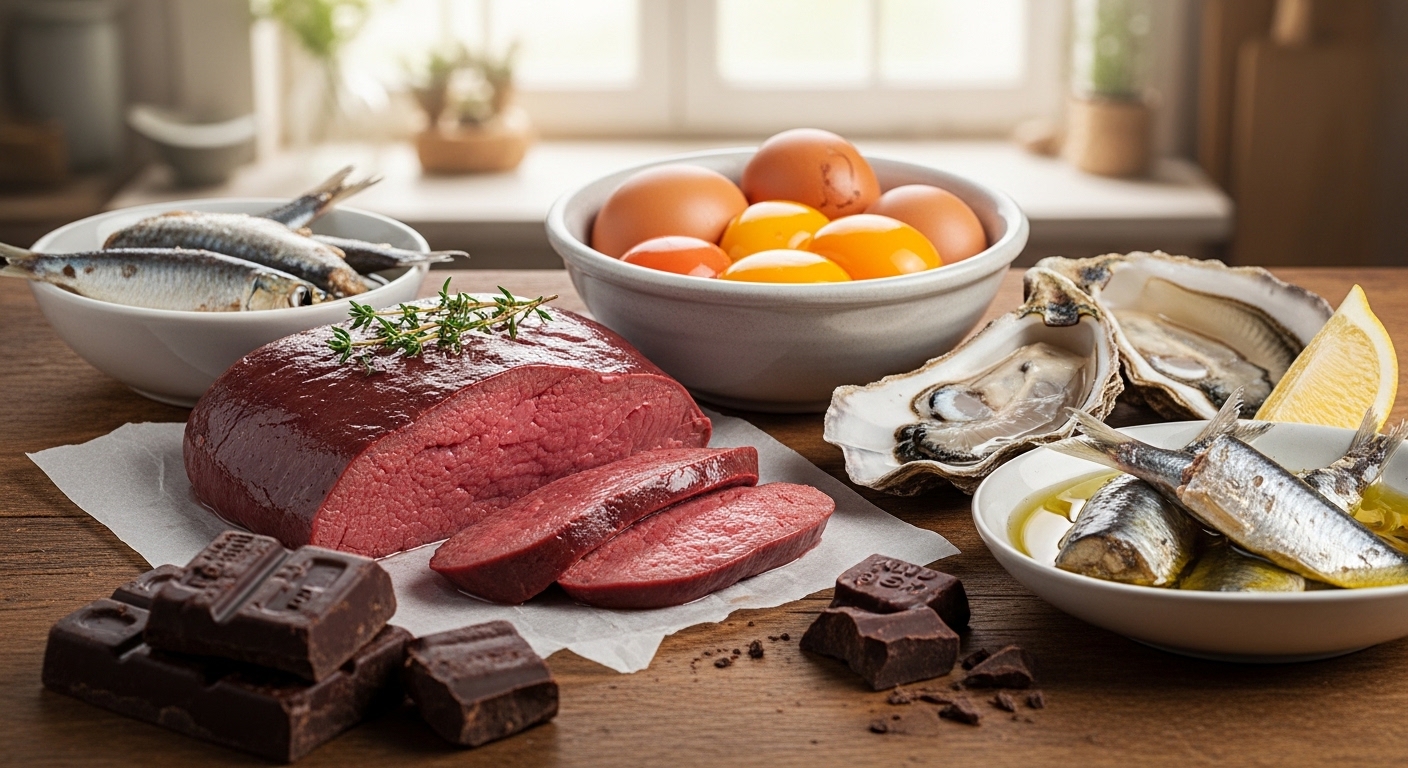
- Natural Polyunsaturated Fats: (The Omega-3 in wild-caught fish, sardines, and pasture-raised egg yolks). They are crucial for brain structure and for putting out inflammation by balancing out the excess Omega-6.
What exactly is cholesterol, and how is it different from fat?
- Fats (triglycerides): These are energy chains that your body “burns” for fuel or stores for later.
- Cholesterol (a sterol): It is not used as energy and provides zero calories. It is the “cement” of your cell membranes and the mold used to manufacture hormones. It is so vital that if you don’t eat it, your liver manufactures it.
The Superpowers of Real Fat in your Body
- Architects of your Hormones: Cholesterol and healthy fats are the raw material for pregnenolone, the mother of all our hormones. From there, testosterone, estrogens, progesterone, and cortisol are born.
- Without fat in men: Testosterone plummets, you lose muscle mass, motivation, and libido.
- Without fat in women: Cycles become irregular, PCOS is exacerbated, infertility arises, or menstruation completely disappears (amenorrhea).
- They turn off Hunger: Fat slows down gastric emptying and sends direct satiety signals to the brain, eliminating cravings.
- They absorb Vitamins A, D, E, and K: These vitamins are fat-soluble; they require fat to cross the intestinal wall. Without healthy fat, your body will simply flush them out even if you consume them.
- Vitamin D and your Internal Sunscreen: Your body uses the cholesterol in your skin to synthesize Vitamin D from the sun. Furthermore, healthy cell membranes act as an “internal sunscreen,” giving your skin resistance against UV rays.
⚠️ THE PLOT TWIST: Context is everything
If saturated fats are so good, why are they still demonized? Because of the context. Saturated fat is excellent on its own, but it becomes a dangerous metabolic hazard when you consume it alongside sugars or complex carbohydrates.
“Your body is a hybrid engine” It can burn glucose or fat, but it cannot process massive amounts of both at the same time. If you eat fat mixed with bread, fries, and a soda, the sugar spikes your insulin. This hormone puts a “padlock” on your cells, blocking their ability to burn the fat. The result: that fat and the excess sugar are stored as visceral fat, generating insulin resistance. The problem wasn’t the fat; it was the hormonal environment created alongside the sugar.
The Blood Test Mystery: Why are my triglycerides high? This leads us to one of the biggest misunderstandings in doctor’s offices. You get a blood test, you see the word “Triglycerides” sky-high, and your doctor says: “You are eating too much fat.” False again! Here is where biochemistry will blow your mind.
As explained earlier, triglycerides are fats traveling in your blood. But when they come back high, it’s almost never because of the natural fat you ate; it is because of the sugar and refined carbohydrates. What happens at the cellular level? When you eat an excess of carbs (bread, pasta, juices, sweets), your body breaks them down into glucose. That glucose floods your liver. Since the liver has a very small storage limit for sugar, when it gets full, what does it do with all that toxic excess? It enters a process called De Novo Lipogenesis (literally, the creation of new fat). Your liver takes all that leftover sugar, packages it, and turns it into… Triglycerides! It then dumps them into your bloodstream to try and store them in your “love handles.”
This is the precise reason why people on diets high in good fats but low in carbohydrates have incredibly low triglyceride levels (because their insulin doesn’t spike and their body uses that fat as constant energy). Conversely, those who eat “low-fat” diets but constantly snack on cereals, oatmeal, excess fruit, and flour have triglycerides bursting their arteries. If you want to lower your triglycerides, don’t drop the pork rinds or the avocado; drop the bread and the sugar.
The Tragedy of fearing them
If you go back to a “low-fat” diet, the body collapses:
- Gallstones: The gallbladder stores bile to digest fats. If you don’t eat fat, the bile stagnates, thickens, and forms painful stones.
- Severe vitamin deficiencies, hormonal chaos, and brain fog.
- Insatiable hunger and dry skin.
📌 YOUR IMMEDIATE ACTION “CHEAT SHEET”
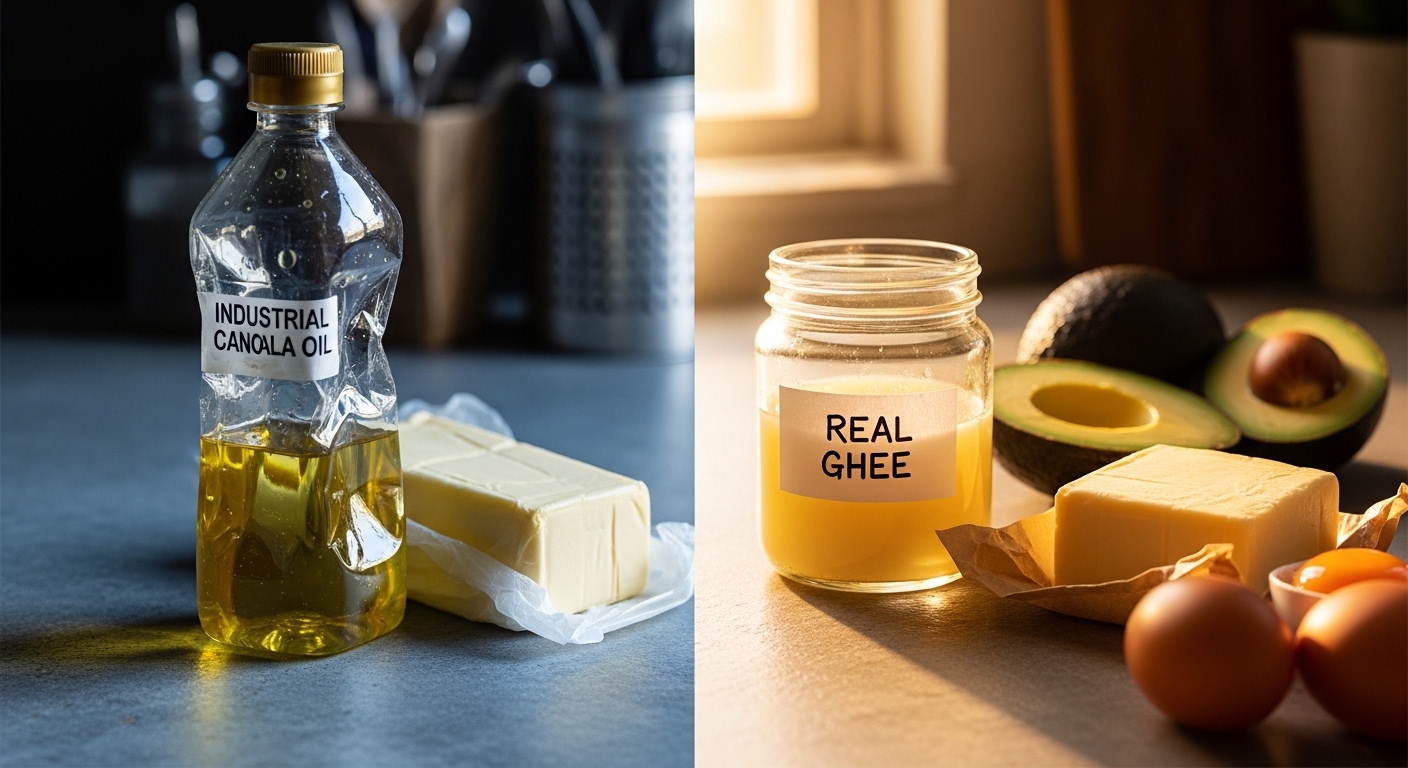
- 🔴 THROW AWAY TODAY: Canola, soy, corn, safflower, and cottonseed oils, margarine, and any partially hydrogenated oils.
- 🟢 COOK WITH (High Heat): Real butter, Ghee, lard, beef tallow, coconut oil.
- 🟡 USE COLD (Never heat): Extra virgin olive oil and avocado oil.
Conclusion: Wake up and Take Back Control
What you just read is backed by modern science and biochemistry. For years, we blamed natural fat for the damage caused by oxidized oils and sugar.
Beware of Dogmas: Sadly, there are countless nutritionists and doctors out there who haven’t opened a biochemistry book since they graduated. A doctor has a moral obligation to stay updated. If your doctor tells you that “cholesterol is bad,” blames your high triglycerides on eating meat, or tells you to take the yolk out of your egg… run the other way. Look for a professional who actually cares about getting to the root cause.
Be careful as well with a segment of the vegan community (to be clear: only some, not all) that will try to scare you about animal fat just to get you over to their ideological side. They do it without scientific rigor, completely ignoring the hormonal collapse the body suffers when deprived of these essential nutrients.
Take back control of your health. Don’t be swayed by water-cooler advice or TV commercials funded by the very industry that makes you sick. Question everything, do your research, and understand your perfect machine. Cooking with ghee, butter, or lard is one of the best decisions you can make for your brain, your arteries, and your hormones. Your body will thank you for the rest of your life.
📚 References & Scientific Evidence
1. On how vegetable oils and oxidized Omega-6 cause heart disease (not saturated fat)
- Study Title: Omega-6 vegetable oils as a driver of coronary heart disease: the oxidized linoleic acid hypothesis.
- Description: Published in the Open Heart journal, this study details step-by-step how seed vegetable oils (high in Omega-6) oxidize in the body. It explains how they cause direct mitochondrial damage and arterial inflammation, acting as the true driver of coronary heart disease and debunking the myth that natural cholesterol is to blame.
- URL: https://pubmed.ncbi.nlm.nih.gov/30364556/
2. Evidence that saturated fat DOES NOT cause heart disease
- Study Title: Meta-analysis of prospective cohort studies evaluating the association of saturated fat with cardiovascular disease.
- Description: A massive meta-analysis published in the American Journal of Clinical Nutrition that reviewed data from nearly 350,000 patients. The conclusion was definitive: there is no significant scientific evidence to conclude that dietary saturated fat is associated with an increased risk of coronary heart disease or stroke.
- URL: https://pubmed.ncbi.nlm.nih.gov/20071648/
3. The official removal of the dietary cholesterol limit
- Document Title: Scientific Report of the 2015 Dietary Guidelines Advisory Committee.
- Description: The official United States government document where the medical expert committee finally admits the historical error and formally states that “cholesterol is not considered a nutrient of concern for overconsumption,” marking the end of the ban on foods like egg yolks and butter.
- URL: https://health.gov/dietaryguidelines/2015-scientific-report/ (Section: “Cholesterol”)
4. How excess carbohydrates (not dietary fat) raise blood triglycerides
- Study Title: Dietary carbohydrate’s effects on lipogenesis and the relationship of lipogenesis to blood insulin and glucose concentrations.
- Description: This research explains De Novo Lipogenesis at the cellular level. It demonstrates how diets high in refined carbohydrates and sugars force the liver to synthesize new fat, drastically spiking blood triglyceride levels and driving insulin resistance.
- URL: https://pubmed.ncbi.nlm.nih.gov/11722834/
5. The massive difference between artificial trans fats (margarine) and natural trans fats (dairy/meat)
- Study Title: Health Effects of Trans-Fatty Acids: Experimental and Observational Evidence.
- Description: Published in the European Journal of Clinical Nutrition, this study explains that while industrial trans fats (partially hydrogenated oils) severely damage the cardiovascular system, natural trans fats generated by ruminant animals do not pose the same risk and have neutral or even beneficial metabolic profiles.
Medical Disclaimer: The information contained in this article by Caloritrack (a product of KAI STUDIOS, S.A.S.) is strictly educational and informational. While we encourage empowerment through knowledge, neither Caloritrack nor KAI STUDIOS, S.A.S. acts as a medical entity. This content does not substitute in any way the advice, diagnosis, or treatment of a qualified medical professional. Every body is unique; always consult your primary care doctor or specialist before making significant changes to your diet, routines, or lifestyle.