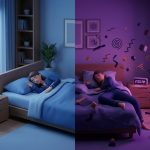


🧠 Feeling overwhelmed by stress or struggling to make decisions? Your hidden superpower is called REM Sleep.
We all know sleep is important, but did you know there is a specific phase of your sleep that acts as your personal therapist and your best advisor?
It’s called REM Sleep (Rapid Eye Movement). It’s the stage of the night where we dream intensely, and even though it only lasts for about 20% of our rest, it is the key to waking up feeling mentally invincible.
If you don’t know anything about the science of sleep, think of it this way: deep sleep repairs your body, but REM sleep repairs your mind.
What is it for in your daily life?
- It’s your therapy against stress and sadness: During REM sleep, your brain processes the difficult things that happened to you during the day, but it does so by shutting off the chemical that causes you anxiety. That is, it takes that problem from work or that argument, and “removes” the heavy emotional load. That’s why, after a good night’s sleep, yesterday’s problems hurt a lot less.
- It helps you make smart decisions: Have you heard the phrase “let me sleep on it”? It is 100% real. In the REM phase, your brain connects ideas that seem entirely unrelated. When you wake up, you see the solution to that problem that had you stuck yesterday, or you see clearly what decision you need to make.
- It accelerates your learning and helps you master new skills: Are you learning to play an instrument, trying to master a coordination exercise like jumping rope, or memorizing information for a presentation? REM sleep is the exact moment where your brain “burns” those movements and data into your memory. Basically, your brain keeps practicing for you while you sleep. For example: If today you try to learn a new song on the guitar and your fingers get tangled, or you keep tripping over the jump rope, by sleeping your full REM cycles, your brain reviews those movements at high speed. That’s why, the next day you wake up, try again and, almost by magic, the movements come out much more fluid and effortless.
- It skyrockets your creativity: If you need to design, write, or propose innovative ideas at work the next day, REM is your best ally. It is a “laboratory” where your mind collides and mixes what you learned today with the entire catalog of memories and experiences you already had. For example: You go to bed blocked, frustrated, and not knowing how to solve a project, and the next morning while you shower or drink your coffee, out of nowhere, a brilliant idea hits you. That’s not a coincidence; it’s the direct result of your REM sleep working at night.
- It’s your “good energy” battery: Waking up after a good REM cycle is the difference between getting up in a good mood, focused, and ready to get things done, or waking up dragging your feet with a mental “fog” that won’t go away even with three coffees.
The REM “Thieves” (What you should AVOID 🚫)
- Sleeping at odd hours (The myth that “8 hours is 8 hours”): Going to bed at 2:00 a.m. and waking up at 10:00 a.m. does NOT give you the same quality of rest as sleeping from 10:00 p.m. to 6:00 a.m. Why? REM sleep has a “prime time” that is anchored to your biological clock and occurs much more strongly in the early hours of the morning. If you sleep during the day or very late, the sunlight and the natural increase in your body temperature in the morning “break” and fragment this phase.
- The nightcap: Alcohol might make you pass out fast, but it is enemy number one of REM sleep. It blocks this phase almost completely in the first half of the night, leaving you with “low-quality” sleep and waking up exhausted.
- Sleeping only 5 or 6 hours: The catch with REM is that most of it happens right in the last few hours before waking up. If your alarm goes off two hours before your body needs it to, you are not losing a little bit of REM… you are robbing yourself of almost your entire dose for the night.
- A hot room: During this phase, your body cannot regulate its own temperature (you don’t sweat or shiver properly). If it’s too hot, your brain gets scared and pulls you out of REM sleep to protect you.
- Your phone in bed: The blue light from your screen makes your brain believe the sun is still shining. This delays melatonin production and “pushes” your REM cycles toward the morning, throwing off your entire biological clock.
- The “5 more minutes” button (Snooze): The worst way to wake up. If your alarm interrupts your best REM cycle of the morning and you go back to sleep, your brain tries to start a brand new sleep cycle from scratch that will just be interrupted again in 9 minutes. The result: severe “sleep inertia,” that feeling of being groggy and heavy for hours.
Your “Optimizers” (What you SHOULD do ✅)
- Sync with the night and be boring with your schedule: Go to bed and wake up at the same time, ideally aligned with natural darkness (like a schedule from 10:00 p.m. to 6:00 a.m. or 11:00 p.m. to 7:00 a.m.). Your brain loves routine; if it knows what time you are going to sleep and you take advantage of the natural hours of darkness, it organizes your REM cycles perfectly.
- Protect the end of your night: Aim for those full 7 to 8 hours. Let your brain finish its emotional cleaning job in the morning.
- Turn your room into a cool cave: Science shows that the ideal temperature for REM sleep to flow without interruptions is between 59°F and 66°F (15°C – 19°C).
- The “one-touch” rule (Your alternative to Snooze): Instead of setting your alarm half an hour early and snoozing it 5 times, set it for the exact time you need to get out of bed. To avoid temptation, leave your phone or alarm clock across the room. By forcing yourself to stand up to turn it off, you break the sleep inertia instantly and save your last REM cycle. (Another excellent “pro” level alternative is using a sunrise simulator alarm clock, which gently tells your brain to end the REM cycle naturally on its own).
- Turn off screens in time: Swap your phone for a book (physical or e-reader without blue light) at least 30 minutes before bed. This way, your brain starts secreting the necessary melatonin at the right time.
💡 Today’s challenge: Tonight, lower your room temperature a bit, go to bed before midnight leaving your phone far from the bed, and make sure to give yourself time to sleep 7 and a half hours. Your brain (and your mood tomorrow) will thank you. Are you up for trying it?
Scientific References
1. Landmark Study: Overnight Therapy? The Role of Sleep in Emotional Brain Processing
- Description: Published in the Psychological Bulletin, this key scientific paper explains the neurochemical mechanism of REM sleep. It demonstrates how REM sleep recalibrates emotional brain networks and reduces noradrenaline (the stress chemical) levels, allowing for the processing of emotional trauma and daily stress without a physiological anxiety response.
- Link: https://www.ncbi.nlm.nih.gov/pmc/articles/PMC2890316/
2. Scientific Review: Alcohol and Sleep I: Effects on Normal Sleep
- Description: A comprehensive review published in Alcoholism: Clinical and Experimental Research. This study aggregates decades of data demonstrating how alcohol acts as a potent REM sleep suppressor, particularly in the first half of the night, causing a “rebound effect” later that severely fragments rest and ruins sleep quality.
- Link: https://pubmed.ncbi.nlm.nih.gov/23347102/
3. Institutional Guide: Sleep, Learning, and Memory (Harvard Medical School)
- Description: Provided by the Division of Sleep Medicine at Harvard Medical School, this resource explains the direct correlation between REM sleep and cognitive function. It details how the brain consolidates memories, acquires new motor skills, and fosters creative problem-solving by connecting disparate pieces of information during the REM cycle.
- Link: https://healthysleep.med.harvard.edu/healthy/matters/benefits-of-sleep/learning-memory
Medical Disclaimer: The information contained in this article by Caloritrack (a product of KAI STUDIOS, S.A.S.) is strictly educational and informational. While we encourage empowerment through knowledge, neither Caloritrack nor KAI STUDIOS, S.A.S. acts as a medical entity. This content does not substitute in any way the advice, diagnosis, or treatment of a qualified medical professional. Every body is unique; always consult your primary care doctor or specialist before making significant changes to your diet, routines, or lifestyle.