




The World Cup Hydration Break Hoax: Science, Tactics, or Pure Business?
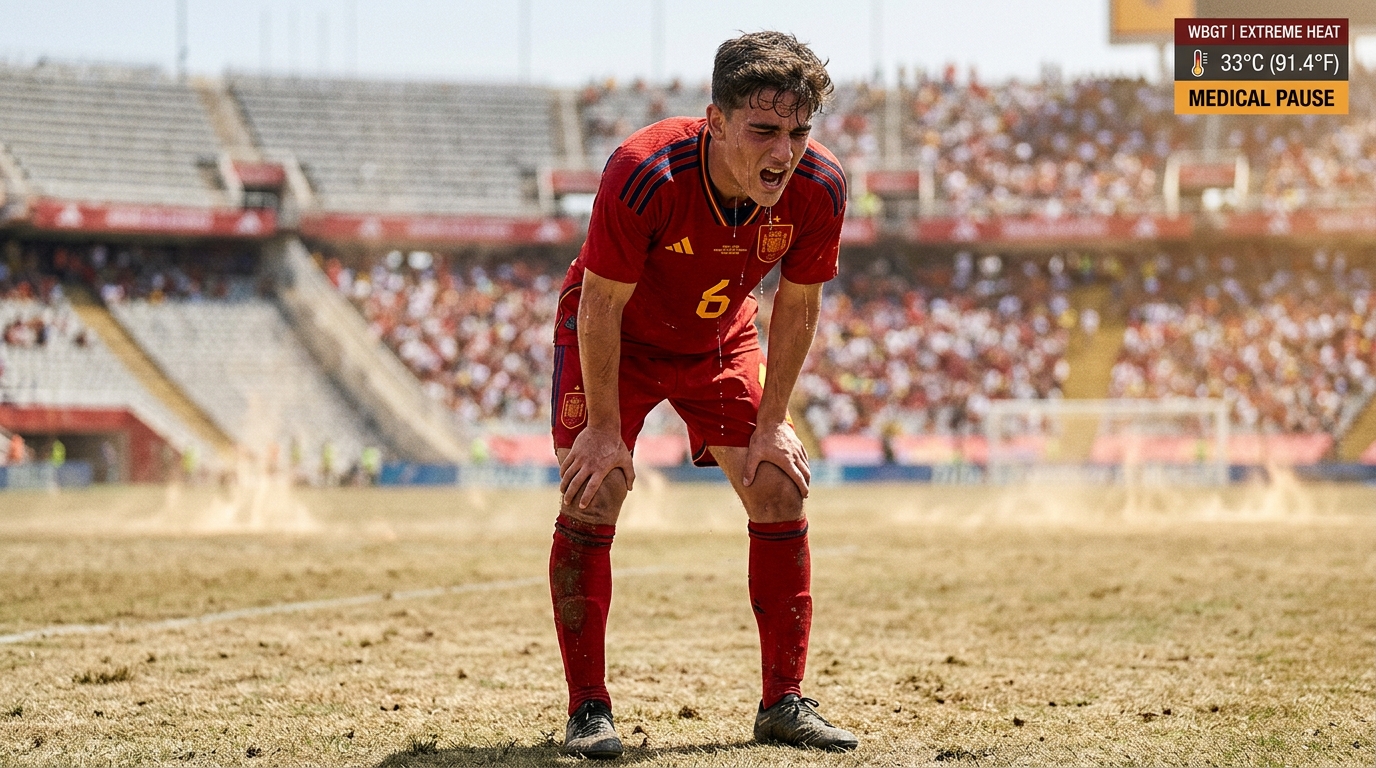
If you’re following the World Cup, you’ve definitely noticed it. The referee blows his whistle at the 30-minute mark, players rush to the sidelines, chug neon-colored liquids, and, while they’re at it, receive frantic instructions from their managers. The famous “hydration break” has become yet another protagonist of the tournament.
But as health professionals and sports lovers, we need to pause and analyze this phenomenon. Is it truly a medical measure to save the lives and performance of athletes, or are we witnessing soccer mutate into a sport of disguised commercial breaks?
Here is the definitive scientific and tactical analysis of the hydration break: the why-yesses, the why-nots, and what no one is telling you on the TV broadcast.
The Science Behind the “Yes”: When the Body Fails
From an exercise physiology standpoint, the hydration break has undeniable scientific backing, but only under extreme conditions.
During an elite match, a player can lose between 1.5 and 3 liters of sweat. Multiple sports medicine studies show that fluid loss equivalent to just 2% of body mass triggers a series of severe deficits:
- Drop in VO2 Max: Aerobic capacity plummets, reducing high-intensity sprints in the final 15 minutes of the match.
- Cognitive decline: Dehydration raises core body temperature (inefficient thermoregulation). This delays brain reaction times; passes fail, and tactical decisions become cloudy.
- Heatstroke risk: The true clinical danger.
The scientific golden rule: For a hydration break to have a real medical justification, FIFA and sports medicine colleges use the WBGT Index (WetBulb Globe Temperature). This metric doesn’t just measure heat; it factors in temperature, relative humidity, solar radiation, and wind. The science is clear: the break only makes physiological sense if the WBGT index exceeds 32°C (89.6°F).
The Resounding “No”: The Destruction of Dynamics and Athletic Meritocracy
This is where science clashes with the essence of the game. If the match is played in a closed-roof stadium with artificial climate control at 22°C, or in a venue with mild weather and low humidity, the hydration break loses all its clinical weight and becomes a sporting aberration.
Soccer is distinguished by its continuous flow. It is not American football, nor is it basketball. Physical wear and tear and fatigue management are intrinsic to the sport. The structure of soccer is based on the manager’s initial strategy and how players solve problems on the pitch for 45 uninterrupted minutes, leading up to the halftime tactical rethink.
Artificially stopping the game completely breaks this dynamic and alters fundamental competitive variables:
- The neutralization of athletic advantage (The fatigue factor): The opponent’s exhaustion is a fundamental tactical weapon that better physically prepared teams can no longer exploit in the same way. At the elite level, managers invest massive resources into specialization, hiring the best fitness coaches and implementing cutting-edge technology to push their athletes’ physiological adaptation to the limit. The rules of the game are the same for everyone, rewarding the meritocracy of rigorous training; however, the hydration break acts as an artificial equalizer. This interruption disproportionately benefits squads with less stamina or subpar physical preparation. By rescuing players from the natural curve of extreme fatigue, it directly penalizes the effort of athletes who train to endure the highest uninterrupted demands. From a purely sporting analysis, the evolution of soccer should incentivize constant athletic improvement, pursuing human excellence, rather than “softening” the game through regulatory interventions that reduce the competitive physical rigor.
- The disguised “Time-Out”: By approaching the sideline, managers get a free timeout that does not exist in soccer’s original rulebook. It gifts them a tactical window halfway through each half, perverting the dynamism and autonomous decision-making of the player on the field.
The Elephant in the Room: Health or Monetization?
If science dictates that the break is only necessary under severe heat and humidity indices, why are we seeing it become increasingly standardized, even in mild climates or climate-controlled stadiums?
Without falling into dogmas or conspiracies, the answer requires a cold look at sports economics. A two to three-minute interruption in the middle of each half creates exactly what soccer traditionally lacks: advertising slots at the climax of viewership.
Those minutes translate into on-screen banners, mentions of sports drink sponsors, and television commercials that previously could only be broadcast before the match, at halftime, or at the end.
The Verdict
The hydration break is an excellent sports medicine tool when the climate environment rigorously demands it. Above 32°C (WBGT), it saves lives and maintains the quality of the spectacle by preventing the cognitive and muscular collapse of the athletes.
However, applying it outside those parameters not only attacks the uninterrupted nature of the game and punishes the effort of physically superior teams, but it also disguises as “health” what appears, by all accounts, to be a brilliant and lucrative commercial strategy that ultimately softens the sport’s level of demand.
References and Scientific Evidence
1. Extreme Weather Regulation and the 32°C (WBGT) Rule
- Title: Extreme Weather in Football – FIFPRO
- Description: Official document from the global professional soccer players’ union (FIFPRO) detailing medical guidelines for extreme weather. It confirms that the hydration break has a clinical basis and is only mandatory when the WetBulb Globe Temperature (WBGT) index exceeds 32°C (89.6°F), working in consensus with the American College of Sports Medicine.
- Hyperlink: https://www.fifpro.org/articles/2021/07/extreme-weather-in-football
2. Physiological Impact of Dehydration on Performance and Cognition
- Title: Dehydration and its effects on performance – Human Kinetics
- Description: Scientific text on sports exercise physiology. It explains the direct impact of fluid loss, demonstrating with medical evidence that a decrease of just 2% of body mass due to dehydration causes a drop in aerobic capacity (VO2 max), reduces cardiac output, and negatively affects cognitive functions, decision-making, and reaction time.
- Hyperlink: https://us.humankinetics.com/blogs/excerpt/dehydration-and-its-effects-on-performance
3. Clinical Study on the Efficacy of Hydration Breaks
- Title: Efficacy of the FIFA cooling break heat policy during an intermittent treadmill football simulation in hot conditions in trained males | ResearchGate
- Description: Clinical trial published on academic research platforms that rigorously evaluates the 3-minute hydration breaks instituted by FIFA. The study scientifically demonstrates that the break helps mitigate cardiovascular strain and thermal wear in soccer players, provided it is applied in severe heat environments of 32°C (WBGT).
- Hyperlink: https://www.researchgate.net/publication/382412363_Efficacy_of_the_FIFA_cooling_break_heat_policy_during_an_intermittent_treadmill_football_simulation_in_hot_conditions_in_trained_males
4. Analysis on Commercialization and the Loss of Sporting Dynamics
- Title: Fifa unites the world – in anger at hydration breaks (AKA ad breaks) | The Guardian
- Description: Critical journalistic analysis on the standardization of hydration breaks in events like the World Cup (regardless of the actual weather). The article explores how this measure is transforming soccer by introducing disguised time-outs (ad breaks), breaking the rhythm of the game to insert multi-million dollar advertising slots, and punishing the meritocracy of physical endurance.
- Hyperlink: https://www.theguardian.com/football/2026/jun/26/fifa-unites-the-world-in-anger-at-hydration-breaks-aka-ad-breaks
Medical Disclaimer: The information contained in this article by Caloritrack (a product of KAI STUDIOS, S.A.S.) is strictly educational and informational. While we encourage empowerment through knowledge, neither Caloritrack nor KAI STUDIOS, S.A.S. acts as a medical entity. This content does not substitute in any way the advice, diagnosis, or treatment of a qualified medical professional. Every body is unique; always consult your primary care doctor or specialist before making significant changes to your diet, routines, or lifestyle.