


Why Motivation is a Trap (and How to Build Steel Discipline)
Have you ever felt a burst of energy at 2 a.m. to change your life completely, only for that feeling to disappear when you wake up? It is not your fault, it is basic biology. And if you keep depending on that feeling to move forward, you will stay stuck forever.
Most of us spend our lives waiting to “feel like it” to act. The problem is that motivation is a temporary emotional state, evolutionarily designed for seeking novelty, not for consistency.
If you want to achieve your medium and long-term goals, you need to stop looking for motivation and start building discipline. It is not magic, it is behavioral engineering. Here we explain how to do it.
1. The Science: Your Brain and Resistance
Neurobiology teaches us that dopamine (the chemistry of desire) spikes with novelty and anticipation, but decays rapidly when an activity becomes routine. Your brain is programmed to get bored with what it already knows.
However, discipline has a real “muscle” in the brain: the Anterior Midcingulate Cortex (aMCC). Recent studies suggest that this area grows specifically when you do things you do not want to do. Every time you overcome laziness or discomfort, you are not only completing a task, you are literally rewiring your brain to be stronger.
2. The Identity Shift: “I Am”, not “I Try”
The most common mistake is focusing on the result (“I want to lose 5 kilos”). The winning strategy is to focus on identity.
The Shift: Instead of saying “I am trying to quit smoking” (which implies you are still a smoker making a sacrifice), say “I am not a smoker”.
The Logic: It is hard to act against who you believe you are. When your identity changes, discipline stops being a struggle and becomes your natural behavior.
3. Design Your Environment (Friction Engineering)
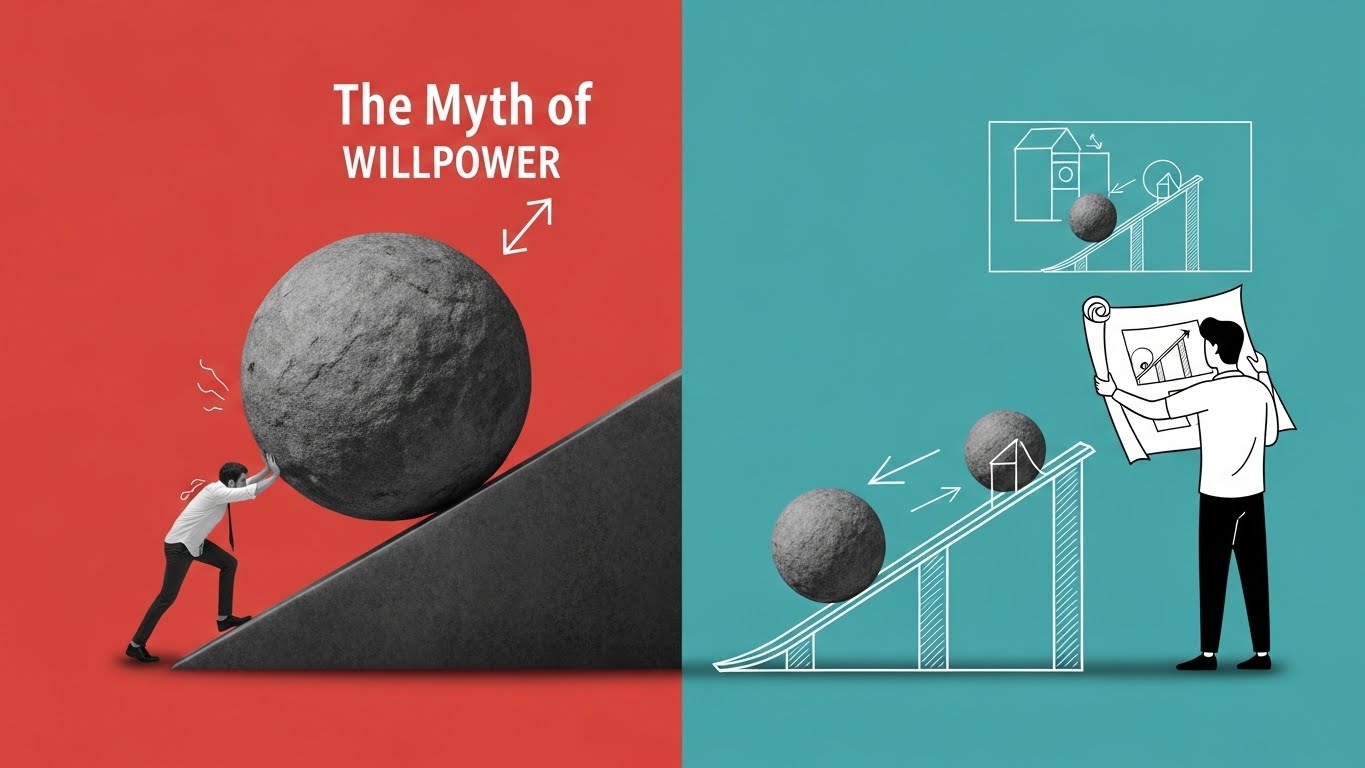
Do not rely on your willpower; it is a limited resource that depletes with stress and decision-making. Instead, design your environment so that discipline is the default option.
For good habits (Reduce Friction): Want to run in the morning? Sleep in your workout clothes or leave them ready next to the bed. Make starting take less than 20 seconds.
For bad habits (Increase Friction): Do you use your phone too much? Put it in grayscale or leave it in another room. Make the bad habit difficult and annoying to execute.
4. Tactical Tools for Everyday Life
The Two-Minute Rule The hardest part is starting. Reduce your new habit to a version that takes less than two minutes. “Read a book” becomes “Read a page”. “Do yoga” becomes “Take out the mat”. Once you start, inertia plays in your favor and it is much easier to continue.
The “Never Miss Twice” Rule No one is perfect. If one day you break your diet or don’t go to the gym, nothing happens. The danger is doing it twice in a row, because that is when a new negative habit is created. If you fail today, your only priority is to get back on track tomorrow.
Your Action Plan: The 30-Day Protocol
Now that you understand the theory, it is time to act. Do not try to change your whole life in one night. Use this progressive protocol to install discipline into your mental operating system without burning out.
Phase 1: Physiological Stabilization (Days 1-7) Discipline is biological. Without sleep and glucose, the prefrontal cortex fails.
- Goal: Regularize sleep.
- Action: Go to bed and wake up at the same time every day. No screens 1 hour before sleeping.
- Micro-Habit: Make the bed every morning. It is the first victory of the day and establishes a pattern of order.
Phase 2: Environment Architecture (Days 8-14)
- Goal: Reduce the need for willpower.
- Action: Environment audit. Eliminate junk food, hide remote controls, delete addictive apps.
- Tactic: Prepare everything needed for the next day the night before (clothes, work materials).
Phase 3: Core Habit Installation (Days 15-21)
- Goal: Start acting.
- Action: Choose ONE single key habit. Apply the 2-Minute Rule. Make it ridiculously easy.
- Tactic: Habit Stacking. “After brushing my teeth, I will meditate for 1 minute”.
Phase 4: Identity and Expansion (Days 22-30)
- Goal: Consolidate the mental shift.
- Action: Evidence journal. Write down 3 things you did that day each night that confirm your new identity (“Today I read, therefore, I am a reader”).
- Tactic: Recovery planning. Write an “If-Then” plan for when the first failure occurs.
How to use this guide:
Do not skip phases: Each week builds upon the previous one. If you try Phase 3 without mastering the sleep of Phase 1, you will fail.
Celebrate the small things: Checking off each completed day releases small doses of dopamine that keep you in the game.
Start TODAY: Don’t wait for Monday. Discipline starts now.
Supporting Scientific Links and References
- [Discussion] What 30-Day Challenge Format Has Worked Best For You? – Reddit, fecha de acceso: enero 7, 2026, https://www.reddit.com/r/getdisciplined/comments/67o32v/discussion_what_30day_challenge_format_has_worked/
- Controlling Your Dopamine For Motivation, Focus & Satisfaction – YouTube, fecha de acceso: enero 7, 2026, https://www.youtube.com/watch?v=QmOF0crdyRU
- Identity-Based Habits: How to Actually Stick to Your Goals This Year – James Clear, fecha de acceso: enero 7, 2026, https://jamesclear.com/identity-based-habits
- Habits Guide: How to Build Good Habits and Break Bad Ones – James Clear, fecha de acceso: enero 7, 2026, https://jamesclear.com/habits
- Environment Design: How to Improve Without Thinking – James Clear, fecha de acceso: enero 7, 2026, https://jamesclear.com/environment-design-organ-donation
- 4-Step Method By James Clear To Break Bad Habits And Build Good Ones | Medium, fecha de acceso: enero 7, 2026, https://booksmyrefuge.medium.com/4-step-method-by-james-clear-to-break-bad-habits-and-build-good-ones-b3b92b6920c
- Self Discipline in the Workplace: Full Guide to Professional Success – Effy AI, fecha de acceso: enero 7, 2026, https://www.effy.ai/blog/self-discipline
- The Brighter Guide to Tiny Habits by BJ Fogg, fecha de acceso: enero 7, 2026, https://workbrighter.co/tiny-habits/
- 16 Self-Discipline Examples for Everyday Life – Motion, fecha de acceso: enero 7, 2026, https://www.usemotion.com/blog/self-discipline-examples.html
- Never Miss Twice: The One Rule That Saves Habits – Medium, fecha de acceso: enero 7, 2026, https://medium.com/@TheChosenVictor/never-miss-twice-c430ea069833
- The Two-Day Rule (aka Never Skip Two Days in a Row) – Love Not Fear, fecha de acceso: enero 7, 2026, https://lovenotfear.com/personal-behaviour/two-day-rule/
Medical Disclaimer: The information contained in this article by Caloritrack (a product of KAI STUDIOS, S.A.S.) is strictly educational and informational. While we encourage empowerment through knowledge, neither Caloritrack nor KAI STUDIOS, S.A.S. acts as a medical entity. This content does not substitute in any way the advice, diagnosis, or treatment of a qualified medical professional. Every body is unique; always consult your primary care doctor or specialist before making significant changes to your diet, routines, or lifestyle.