




Why Avoiding Fats Made You Gain More Belly Fat (And How Olive Oil and Eggs Reverse It)
You have probably been there yourself—or know someone in this exact situation: the number on the scale doesn’t look alarming and basic blood work comes back “normal,” yet your pants feel tighter around the waist every month and a heavy 3:00 PM energy crash becomes impossible to ignore.
When we think about losing belly fat, we usually focus on aesthetics, but medical research reveals a much more interesting story beneath the surface. Not all body fat behaves the same way, and understanding how it works metabolically—backed by clinical trials and studies indexed on PubMed—makes reducing it far easier without resorting to extremes or absurd food bans.
What Exactly Is Visceral Fat (And What Does Your Liver Have to Do With It)?
To put it in practical terms, imagine going on a road trip with too much luggage:
- Subcutaneous fat: This sits right beneath the skin where you can pinch it with your fingers—like packing suitcases into the trunk or onto the roof rack.
- Visceral fat: Stored deep inside the abdomen around vital organs like the liver, pancreas, and intestines—like cramming bags right under the hood against the engine.
Once that fat surrounds the “engine,” it stops acting like a passive storage unit. Visceral tissue releases fatty acids and inflammatory molecules that travel straight to the liver. When storage reaches capacity, liver cells themselves begin filling up with fat droplets—a condition known as hepatic steatosis, or fatty liver.
What makes this tricky—and well documented in clinical literature—is that the process is usually silent. A person can accumulate significant visceral and liver fat without feeling pain or showing elevated liver enzymes (such as ALT) on a routine blood test. Still, the body feels the strain of an overworked engine: blood sugar becomes harder to regulate, afternoon fatigue sets in, and overall metabolism loses efficiency.
Here, it is worth clearing up a very common myth without judgment: you don’t need to have obesity or carry noticeable extra weight to accumulate visceral fat—even very thin people can develop it without realizing it. In clinical studies on PubMed, researchers frequently describe naturally lean individuals with a “normal” weight on the scale who silently store fat around their organs, especially when they spend long hours sitting, carry low muscle mass, and regularly rely on sodas, sweetened coffees, or pastries to get through the day. Think of that friend or coworker who seems to eat whatever they want without going up a size, yet feels drained every afternoon: even if no extra volume shows on the outside, on the inside their liver is processing that exact same overload. Recognizing this removes body-shape stereotypes and reminds us that metabolic health goes far beyond outward appearance.
The good news backed by human physiology is twofold: the liver has an extraordinary capacity to regenerate within a matter of months, and visceral fat is metabolically very active—meaning it is typically the first to go as soon as you adjust your daily habits.
The 4 Main Drivers Behind Visceral Fat
For years, people assumed eating dietary fat was the main culprit behind belly fat. Today, metabolic studies show that visceral fat storage responds primarily to hormonal signals (especially insulin), nutrient quality, and energy surplus. Here are the four causes with the strongest scientific evidence:
1. Excess Liquid Fructose
Glucose (found in foods like rice or potatoes) is like an office task that any employee in the company can handle: your muscles, brain, and organs all use it for energy. Fructose, by contrast, can only be processed by a single department: your liver.
Eating a whole apple poses no problem at all because its fiber slows absorption and the total amount of fructose is modest. The real bottleneck happens when drinking sodas, bottled sweet teas, industrial fruit juices, or products made with high-fructose corn syrup. Because it arrives all at once in liquid form, the liver’s inbox gets overwhelmed, and the excess is rapidly converted into newly formed fat through a process called de novo lipogenesis—accumulating directly in the liver and abdomen.
2. Constant Refined Sugars and Starches
White bread, pastries, cookies, pasta, sugary cereals, and hidden ingredients in ultra-processed foods (such as maltodextrin or modified food starches) spike blood glucose quickly and keep insulin elevated throughout the day. As long as insulin stays high from frequent snacking and excess calories, the body receives a continuous signal to keep storing reserves—locking the door against burning stored abdominal fat.
3. Low Choline Intake
This is one of the least known yet best-established factors on PubMed and by institutions such as the National Institutes of Health (NIH). Choline is an essential nutrient that acts like the liver’s fleet of “delivery trucks”: it packages fat so it can be exported out of the organ and used for energy.
Adults need between 425 and 550 mg of choline per day, yet most people fall well short because they rarely eat its richest dietary sources, such as egg yolks. Without enough delivery trucks, fat simply gets stuck inside the warehouse.
4. Fried Foods and Refined Oils in Ultra-Processed Products
Frequently eating deep-fried restaurant foods or relying heavily on commercial salad dressings, industrial mayonnaises, and packaged snacks adds large amounts of refined vegetable oils (soybean, corn, and sunflower oils exposed to high heat). Within a diet high in sugars and excess calories, an overload of these oxidized oils promotes oxidative stress and cellular inflammation in visceral tissue.
Science-Backed Foods to Fight Visceral Fat
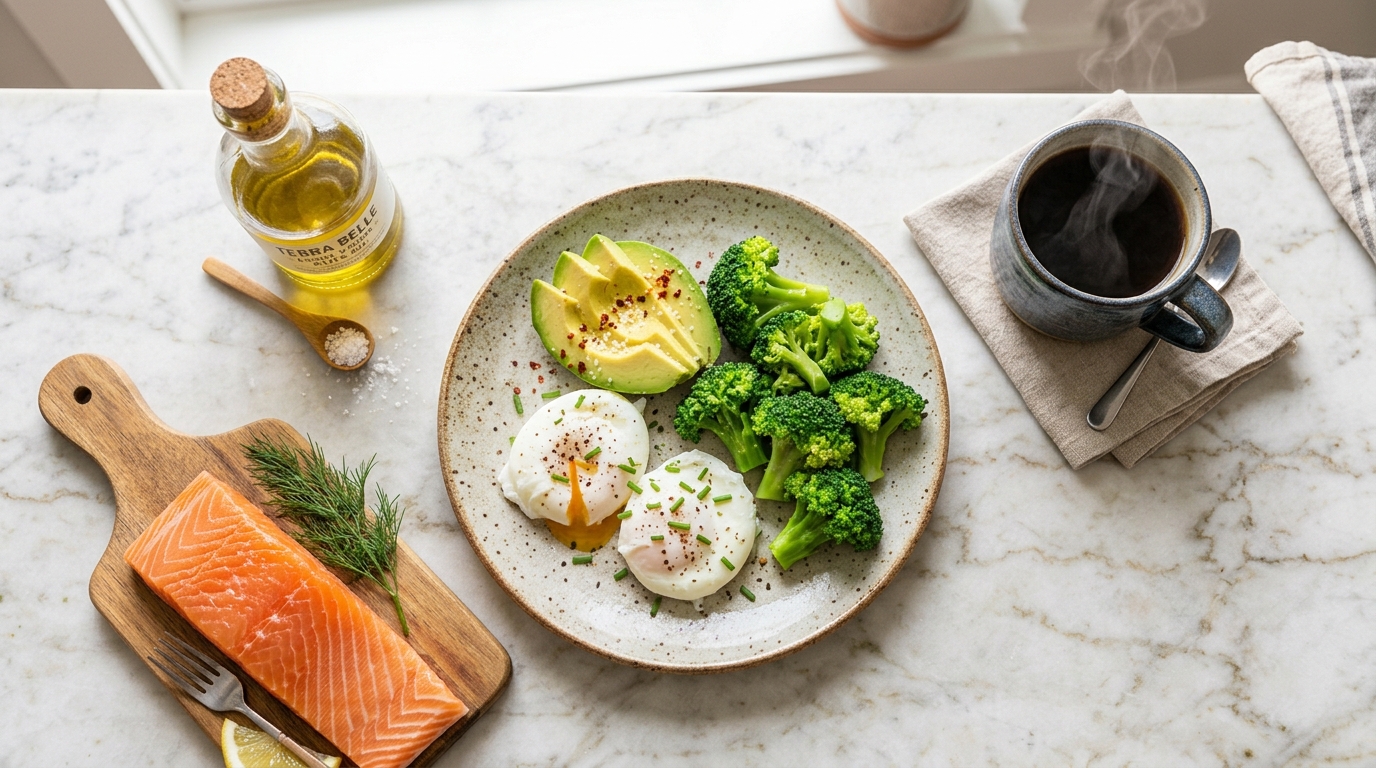
You don’t need exotic ingredients or impossible meal plans. Multiple randomized controlled trials in humans have shown that adding specific everyday foods improves insulin sensitivity, protects the liver, and supports abdominal fat loss:
- Whole eggs: A single egg yolk provides around 140 mg of highly bioavailable choline, helping mobilize liver fat without spiking blood glucose.
- Olive oil: In clinical trials, using raw extra-virgin olive oil as the primary dietary fat reduced liver fat by up to 39% thanks to its polyphenols.
- Fatty fish: Salmon, sardines, and fresh tuna supply omega-3 fatty acids (EPA and DHA)—healthy fats that lower abdominal and hepatic inflammation.
- Fresh garlic: Crushing it and letting it rest for 10 minutes before cooking releases allicin, a compound that activates fat-oxidation pathways.
- Cruciferous vegetables: Broccoli, cabbage, cauliflower, and Brussels sprouts provide fiber and sulforaphane, boosting glutathione—your body’s master antioxidant.
- Fermented foods: Two daily tablespoons of raw sauerkraut deliver Lactobacillus plantarum, strengthening the gut lining and improving liver enzymes in clinical studies.
- Black coffee: Multiple meta-analyses confirm that coffee polyphenols protect liver tissue and support metabolic health, whether caffeinated or decaf.
- Avocado: A clinical trial published in The Journal of Nutrition showed that daily intake helps redistribute body fat, lowering the visceral proportion.
Everyday Habits to Accelerate Sustainable Results
Upgrading your pantry is half the equation; the other half comes down to structuring your daily routine so your body actually gets the chance to tap into that stored energy:
- Cut out liquid calories: Swap sodas, sweetened drinks, and bottled juices for sparkling water with lemon, unsweetened herbal teas, or black coffee.
- Give your digestive system a break: Eating an earlier dinner and leaving 14 to 16 hours before breakfast (skipping late-night TV snacks) lowers insulin and activates visceral fat burning.
- Mind your electrolytes: If you try slightly longer intermittent fasting windows (16 to 18 hours), adding a pinch of sea salt to water prevents fatigue from natural sodium loss as insulin drops.
- Know your true portions: Foods like olive oil, avocado, and eggs are nutrient powerhouses, yet they still provide energy worth balancing around your personal goals.
How to Estimate Your Visceral Fat at Home: The Waist-to-Height Ratio (WHtR)
If the bathroom scale and traditional Body Mass Index (BMI) can’t tell the difference between muscle, subcutaneous fat, and internal fat, how can you check at home whether you are storing visceral tissue without getting a CT scan? The evidence-based clinical answer is the Waist-to-Height Ratio (WHtR)—calculated by dividing your waist measurement (taken at belly-button level) by your height, using the same unit (centimeters or inches) for both.
In comparative studies indexed on PubMed against abdominal CT and DXA scans, WHtR demonstrated a diagnostic accuracy between 86% and over 90% for detecting visceral obesity, ranking as the most reliable physical indicator in both men and women. International medical organizations use a simple rule of thumb: keep your waist circumference to less than half your height.
- Less than 0.50: Healthy level of abdominal fat.
- 0.50 to 0.59: Moderate visceral fat accumulation—a great time to adjust daily habits.
- 0.60 or higher: Elevated visceral fat levels that warrant priority attention.
For example, if someone is 170 cm (67 inches) tall and their waist measures 90 cm (35.5 inches), their score is 0.53: even if their total weight looks normal in the mirror, that number signals that visceral fat is starting to build up around their organs.
Reducing visceral fat doesn’t require living on plain lettuce or giving up your favorite meals forever. It comes down to giving your metabolism the right raw materials, spacing out your meals sensibly, and maintaining a sustainable energy balance. If you want a clear picture of how much energy and what nutrients you are getting each day without tedious manual math, relying on practical tools like CaloriTrack lets you stay on top of your everyday meals and see how your energy and waistline respond week after week.
To track this automatically right from your phone, we invite you to install the CaloriTrack app at caloritrack.com. Inside the app, you have a built-in Waist-to-Height Ratio (WHtR) calculator where you simply enter your body measurements to see your level instantly, with no complicated formulas. Plus, you can check your complete measurement history, view clear progress charts over time, log your daily meals, and discover how small everyday adjustments transform your metabolic health.
Scientific and Bibliographic References
- Body fat distribution and risk of cardiovascular disease: an update (Circulation, Després, 2012)
- Description: Explains the metabolic distinction between subcutaneous and visceral adipose tissue, showing how visceral fat releases free fatty acids and inflammatory cytokines directly to the liver.
- Hyperlink: View on PubMed
- Clinical and histologic spectrum of nonalcoholic fatty liver disease associated with normal ALT values (Hepatology, Mofrad et al., 2003)
- Description: Demonstrates that significant hepatic fat accumulation and cellular inflammation frequently occur even when routine blood panels report normal ALT liver enzyme levels.
- Hyperlink: View on PubMed
- The missing risk: MRI and MRS phenotyping of abdominal adiposity and ectopic fat (Obesity, Thomas et al., 2012)
- Description: Uses MRI imaging to characterize normal-weight, lean individuals who silently accumulate elevated visceral and hepatic fat due to sedentary habits and poor diet quality.
- Hyperlink: View on PubMed
- Consuming fructose-sweetened, not glucose-sweetened, beverages increases visceral adiposity and lipids and decreases insulin sensitivity in overweight/obese humans (Journal of Clinical Investigation, Stanhope et al., 2009)
- Description: Clinical trial proving that liquid fructose drives hepatic de novo lipogenesis, impairs insulin sensitivity, and directly expands visceral fat volume.
- Hyperlink: View on PubMed
- Fructose and sugar: A major mediator of non-alcoholic fatty liver disease (Journal of Hepatology, Jensen et al., 2018)
- Description: Reviews the mechanisms by which refined sugars and rapidly absorbed starches sustain elevated insulin levels and inhibit hepatic fatty acid oxidation.
- Hyperlink: View on PubMed
- Choline: an essential nutrient for public health (Nutrition Reviews, Zeisel & da Costa, 2009)
- Description: Establishes choline’s essential role in packaging and exporting triglycerides out of liver cells via VLDL particles, preventing fatty liver development.
- Hyperlink: View on PubMed
- Choline: Fact Sheet for Health Professionals (National Institutes of Health – Office of Dietary Supplements)
- Description: Documents the daily adequate intake of 425 to 550 mg of choline for adults and confirms whole egg yolks as one of the richest bioavailable food sources.
- Hyperlink: View on NIH
- Association of long-term consumption of repeatedly heated mix vegetable oils in different doses and hepatic toxicity through fat accumulation (Lipids in Health and Disease, Ambreen et al., 2020)
- Description: Investigates how refined vegetable oils subjected to repeated high-heat frying produce oxidized lipid byproducts that trigger hepatic oxidative stress and fat storage.
- Hyperlink: View on PubMed
- The Mediterranean diet improves hepatic steatosis and insulin sensitivity in individuals with non-alcoholic fatty liver disease (Journal of Hepatology, Ryan et al., 2013)
- Description: Randomized crossover trial showing a 39% relative reduction in liver fat using extra-virgin olive oil as the primary fat source compared to a low-fat, high-carbohydrate diet.
- Hyperlink: View on PubMed
- Omega-3 supplementation and non-alcoholic fatty liver disease: a systematic review and meta-analysis (Journal of Hepatology, Parker et al., 2012)
- Description: Systematic review and meta-analysis confirming that marine omega-3 fatty acids (EPA and DHA) significantly reduce hepatic fat content in humans.
- Hyperlink: View on PubMed
- Effect of garlic powder supplementation on hepatic steatosis and liver enzymes in patients with non-alcoholic fatty liver disease: a double-blind randomized controlled clinical trial (British Journal of Nutrition, Sangouni et al., 2020)
- Description: Double-blind randomized clinical trial demonstrating significant reductions in hepatic steatosis and serum liver enzymes following daily garlic intake.
- Hyperlink: View on PubMed
- Sulforaphane-rich broccoli sprout extract improves hepatic abnormalities in male subjects (World Journal of Gastroenterology, Kikuchi et al., 2015)
- Description: Randomized placebo-controlled trial showing that sulforaphane from cruciferous vegetables upregulates glutathione pathways and lowers liver injury markers.
- Hyperlink: View on PubMed
- Effects of probiotics on nonalcoholic fatty liver disease: a meta-analysis (World Journal of Gastroenterology, Ma et al., 2013)
- Description: Meta-analysis of randomized trials showing that probiotic strains including Lactobacillus strengthen gut barrier function, improve insulin resistance, and lower ALT levels.
- Hyperlink: View on PubMed
- Coffee consumption and health: umbrella review of meta-analyses of multiple health outcomes (BMJ, Poole et al., 2017)
- Description: Umbrella review of over 200 meta-analyses confirming that both caffeinated and decaffeinated coffee consumption strongly correlate with lower risk of fatty liver and fibrosis.
- Hyperlink: View on PubMed
- Avocado Consumption, Abdominal Adiposity, and Oral Glucose Tolerance Among Persons with Overweight and Obesity (The Journal of Nutrition, Khan et al., 2021)
- Description: Randomized controlled trial demonstrating that daily avocado consumption promotes healthier abdominal fat distribution by lowering the visceral-to-subcutaneous fat ratio.
- Hyperlink: View on PubMed
- Flipping the Metabolic Switch: Understanding and Applying the Health Benefits of Fasting (Obesity, Anton, Mattson et al., 2018)
- Description: Details how extending daily fasting windows lowers circulating insulin and shifts cellular metabolism toward mobilizing visceral and hepatic fat stores.
- Hyperlink: View on PubMed
- The effect of insulin on renal handling of sodium, potassium, calcium, and phosphate in man (Journal of Clinical Investigation, DeFronzo et al., 1975)
- Description: Landmark human physiology study showing insulin’s sodium-retaining action in the kidneys, explaining increased urinary sodium loss when insulin drops during fasting.
- Hyperlink: View on PubMed
- Prediction of whole-body fat percentage and visceral adipose tissue mass from five anthropometric variables (PLOS ONE, Swainson et al., 2017)
- Description: Evaluates anthropometric indices against DXA scans and identifies Waist-to-Height Ratio (WHtR) as the strongest predictor of visceral fat mass in both men and women.
- Hyperlink: View on PubMed
- Evaluation of the accuracy of anthropometric clinical indicators of visceral fat in adults and elderly (PLOS ONE, Roriz et al., 2014)
- Description: Validates WHtR against abdominal CT scans, reporting diagnostic accuracy between 86% in women and over 90% in men for identifying excess visceral fat.
- Hyperlink: View on PubMed
- Waist-to-height ratio is a better screening tool than waist circumference and BMI for adult cardiometabolic risk factors: systematic review and meta-analysis (Obesity Reviews, Ashwell, Gunn & Gibson, 2012)
- Description: Meta-analysis of more than 300,000 adults supporting the universal clinical threshold of keeping Waist-to-Height Ratio below 0.50 to minimize cardiometabolic risk.
- Hyperlink: View on PubMed
Medical Disclaimer: The information contained in this article by Caloritrack (a product of KAI STUDIOS, S.A.S.) is strictly educational and informational. While we encourage empowerment through knowledge, neither Caloritrack nor KAI STUDIOS, S.A.S. acts as a medical entity. This content does not substitute in any way the advice, diagnosis, or treatment of a qualified medical professional. Every body is unique; always consult your primary care doctor or specialist before making significant changes to your diet, routines, or lifestyle.